
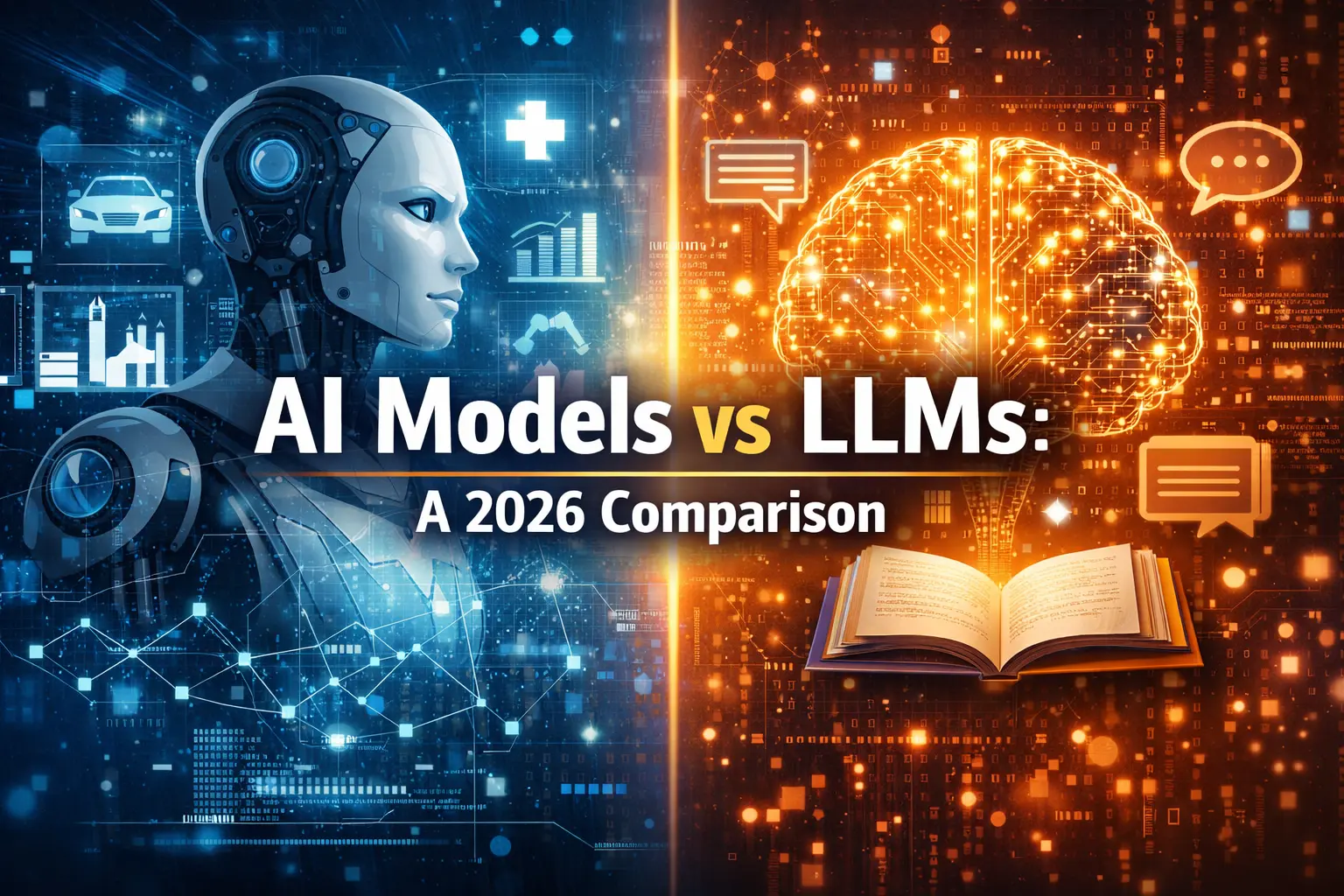
AI Models vs LLMs: A 2026 Comparison
AI-duty is now a fundamental part of modern hardware and software. By 2026, it would appear that AI will be present in almost every industry, such as education, healthcare, business, entertainment and communication. Countless people are now harnessing AI tools every day of their lives without even realising it. But as AI technology evolves, so do its new buzzwords, and people may get confused by them. Two of the most prominent names being thrown around these days are AI models and LLMs. Sometimes these words are used interchangeably as if they mean exactly the same thing when, in fact, they do not. This is a very important distinction to make for students, professionals, and general users. In this article, we will explain in simple terms what AI models and LLMs are, how they work, and how they differ.
What Are AI Models?
 An AI model is, in essence, a computer program trained to accomplish intelligent tasks. These tasks usually require human-like reasoning and decision-making. AI models are generated using machine learning (ML) and deep learning (DL) techniques. They are trained on large amounts of data to identify patterns and make decisions. For instance, when you unlock your phone with face recognition, an AI model is running behind the scenes. When Netflix recommends movies you may like, an AI model analyses your preferences. AI models are employed to detect illness in hospitals, to identify fraud in banks, and to operate smart machinery in factories. Therefore, AI models are extremely general and can be applied to a wide variety of tasks in the real world.
Different Types of AI Models
Multiple types of AI models are being employed in 2026. A few models for AI are made to work on images and videos. These are called computer vision models. Other models are designed to decipher spoken language – these are known as speech recognition models. Some tools assist in forecasting tasks, such as weather forecasting or sales prediction. Specialised AI models are also used in robotics to operate robots and machines. LLMs belong to a separate category focused on language. This shows that from a broad field, while LLMs represent a specialised subset. That is why these terms should not be used interchangeably.
What Are Large Language Models (LLMs)?
LLM is an acronym for Large Language Model. An LLM is a particular kind of AI model that is solely concerned with processing human language. Rather than general-purpose models, LLMs are trained predominantly on text. They read books, websites, articles and online discussions. Because of this massive training, LLMs become highly proficient in language tasks. Applications of LLMs in 2026 include chatbots, virtual assistants, content generation tools, and more. Famous examples include ChatGPT, Google Gemini, and several other widely used systems. LLMs can answer questions, write essays, summarise long documents, translate languages, and even write and debug code. Text is their primary focus, although modern systems may integrate LLMs with other AI models.
Key Difference Between AI Models and LLMs
 The most significant distinction between AI models and LLMs can be summed up in one sentence.LLMs are a subset of AI models. AI models, however, refer to a much broader category of intelligent systems. LLMs are just a particular type of AI model that is focused on language. AI models can handle numbers, images, videos, sounds, and sensor data, whereas LLMs work with text and language. LLMs focus on words, sentences, and human language. Thus, an LLM can help you write an email, but it cannot drive a car or analyse an X-ray. That fundamental difference helps us see why each of those technologies is valuable, but they have different uses.
How Traditional AI Models Work
Traditional AI models are usually trained on structured, task-specific data. The developers collect task-specific data, and the model is trained on this data. For example, that model is trained with thousands of medical images, so it can recognise diseases. A predictive financial AI model is trained on market data. These models are usually designed for one purpose only. They do one job very well, but they can’t easily do something else. For instance, if you train an AI model for recognising faces, it will only do that. It cannot write stories or answer questions all of a sudden. This task-oriented nature is, in fact, one of the main characteristics of most AI models.
How LLMs Work
LLMs operate quite differently from typical ones. Rather than being trained on structured numerical data, LLMs are trained on massive amounts of text. They learn grammar, sentence structure, the meanings of words, and writing styles, enabling them to generate human-like responses. When you ask an LLM a question, it predicts the best answer based on its training data. In 2026, LLMs have matured to the point that they can converse naturally with users. They are a favourite resource for students to learn, writers to produce content, and businesses to provide customer support. However, they do not think or understand like humans. They base their responses on patterns in the data.
Strengths of AI Models
 AI models have numerous real-world benefits. They are almost always quite accurate and dependable for the one thing they do. Domain-specific AI models have extensive applications in critical sectors such as healthcare, aviation, and mechanical engineering. They are also incorporated into security systems, smart cities, and scientific studies. Another benefit is that AI models can be trained on various types of data, including images, sounds and signals. That is what makes them such powerful tools for automating things and solving problems. In 2026, technologies such as self-driving cars would not be possible without conventional AI models.
Strengths of LLMs
LLMs have a lot of advantages that also contribute to their popularity today. Perhaps their strongest point is that they appear to speak naturally to humans. Anyone can use an LLM without needing to know the technology. You just type in a query, and the LLM gives you an answer. LLMs can be used to great effect for writing, education, research, and business communication. Today, LLMs are widely used to draft e-mails, write reports, brainstorm ideas and even pick up new skills. And the benefit is that a single LLM can handle multiple language tasks. For translation, summarising, and conversation tasks, you don’t need multiple systems. One LLM can do all these things very well.
Limitations of AI Models
But that does not mean that traditional AI approaches do not have limitations. Most AI models are highly specialised and are not easily transferable to other tasks. They need a lot of quality data to train. Creating an AI model can be costly and time-consuming. When bad data is used for training, the model will be bad. Unless you are building a specific-purpose model, you should not expect AI models to understand human language unless designed for it. For instance, the AI model used to detect fraud in banks will not help you write a letter or explain your thoughts. These limitations imply that AI models, while powerful, are not that flexible.
Limitations of LLMs
LLMs also have their own limitations. They are intelligent-sounding, but they are fallible and can spit out misinformation. LLMs have neither understanding nor feelings. They generate responses based on learned patterns rather than true understanding. They can sometimes churn out obsolete or inaccurate information. LLMs cannot manipulate the physical world. They cannot analyse medical images, operate robots, or drive cars. Experts warn not to rely fully on LLMs for critical decisions. They are great servants, but they were never meant to be perfect substitutes for human intelligence or problem-specific AIs.
Real-World Applications in 2026
In the real world of 2026, LLMs are applicable in different fields. They are widely used in hospitals for medical diagnosis, in banks for credit card fraud detection, and in industries for automation. Security cameras, smart homes, and scientific investigations also employ them. LLMs, by contrast, are primarily employed for communication-related tasks. They enable chatbots for companies, assist students in studying, and let authors generate content. LLMs are now being used by many companies for customer support and marketing. This is to say that the two technologies are monolithic ‐ each has a necessary part to play, and they serve to complement rather than compete.
Which One Is Better?
Many people ask which is better: AI models or LLMs.None is inherently superior to the other. They are designed for different things. Traditional are better if you want to analyse images, predict numbers, or run machines. LLMs, on the other hand, are better if you need writing assistance, communication, or want to read text. In practice, both are used in many systems. For instance, a smart robot might employ AI models to see and move, and an LLM to have a conversation with people. AI’s future in 2026 is all about combining the two technologies, rather than selecting one over the other.
Future of AI Models and LLMs
The prospects for AI models and LLMs are very promising. With better data and improved methodologies, AI models are becoming more powerful and accurate. At the same time, LLMs are becoming better at understanding and producing human language. In 2026, many new hybrid systems are being designed, combining language models with other forms of AI. This pairing is contributing to the development of smarter applications for education, healthcare, business and everyday living. Rather than supplanting each other, AI models and LLMs are working together to develop more sophisticated and practical tools for the future.
Conclusion
LLMs and traditional AI models are both great and necessary stones of the modern AI ecosystem. However, this does not mean they are identical or interchangeable. They are a large class of intelligent systems that can handle a wide variety of tasks, from recognising images to forecasting patterns to running intelligent machines. However, LLMs are a specialised kind of model that is primarily focused on reading, generating and interpreting human language. A clear understanding of the difference between these two technologies can help users, enterprises and developers to select the right tool for their needs. In 2026, LLMs enable everyday life and industry transformation. They are not enemies but complementary technologies that coexist harmoniously. This is going to be important for anyone who wants to succeed in a world that’s going to be increasingly driven by AI.

