
AI Healthcare: Better Healthcare for Everyone
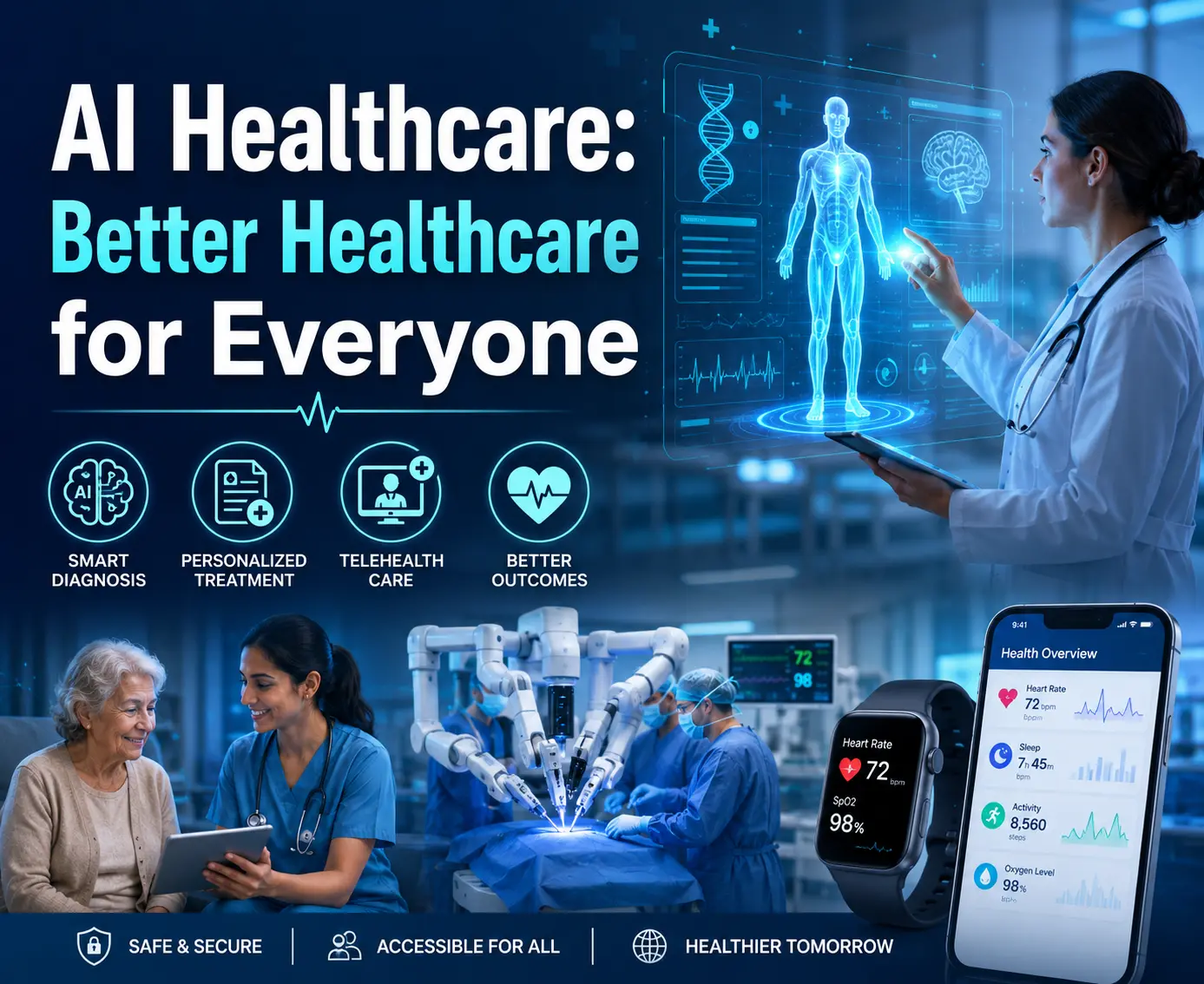
AI is transforming the healthcare system. Numerous healthcare organizations, practices, and research companies are implementing AI to enhance, expedite, and cut the costs of healthcare. Before, clinicians could only draw upon their expertise and laboratory tests. Currently, AI facilitates healthcare professionals in examining a huge amount of clinical data faster and more accurately than ever. Subsequently, health practitioners are delivering reliable results and quick services to patients. AI enables people to access remote healthcare services through virtual assistants and online appointment systems. Although not comprehensive enough to replace doctors, research provides strong evidence that AI can provide support in healthcare and make it universally available.
Early Disease Detection
The most significant advantage of AI in medicine is the early diagnosis of disease. AI systems can detect diseases like cancer, diabetes, and heart disease at an early stage. AI can analyze blood test results, medical scans, patient records, and medical histories, and so on, for traces of the disease before it has developed to be fatal, allowing doctors to diagnose patients more quickly and precisely. Furthermore, the risk of ‘human error’ would be very minimal because AI can analyze thousands of records within minutes. Early detection will result in a quicker transition into a phase of treatment.
AI Improves Medical Imaging
Additionally, another use of artificial intelligence in medicine can be made with medical images. So, in a nutshell, doctors are essentially being aided by AI when they are reading ultrasound, X-ray, MRI or CT scans. Since medical imaging will often require careful examination because small changes in an organ may indicate a serious disease, the aid provided to doctors by AI software is highly useful. But it does not replace doctors or healthcare professionals as the diagnosis becomes more accurate. It may allow doctors to see minute abnormalities that are hard to see with the naked eye or to help doctors make better diagnoses. The current speed of image analysis is also greatly boosted, which is advantageous as some patients demand prompt treatment. The future of AI will also help to increase the accuracy of medical imaging.
Personalized Treatment for Every Patient
AI is revolutionizing healthcare through personalized medicine, which is perhaps the most significant benefit of AI. People are completely different in terms of health problems, lifestyles, and genetics. AI learns from each patient’s data to recommend the most suitable treatment plans. It allows medical professionals to offer efficient treatment according to each patient instead of the same solution to everyone. AI can observe how patients react to specific medications and adaptively suggest a better alternative, which will result in fewer side effects. It can help doctors to select proper treatments according to the different needs and disease conditions of patients. Applications of AI in medicine will lead to personalized medicine.
Telemedicine and Virtual Healthcare
AI is also providing remote and virtual healthcare services. Many people live far from hospitals or find traveling to a doctor time-consuming. AI-enabled online bots and virtual health care helpers will also be utilized to provide advice, reminders, appointments, and basic health care to the residents in their non-clinical setting. One advantage that doctors have with digital health doctors can interview and converse with their patients online over a video call. Employers can pre-populate patient data before the appointment, thus giving the doctor a longer time to deliver more patient care and treatment. Visiting an AI-enabled virtual doctor will save the patient time and money spent on travel.
Helping Doctors Make Better Decisions
 Doctors using AI will work more efficiently and accurately. Hospitals will need to have millions of data points about each patient. All of the information, like medical history, lab results, MRI, EKG, and X-ray information, will be saved on the computer. It takes hours, if not days or even weeks, but with a computer, it’s seconds. It analyzes the health care information and provides diagnoses, treatment alternatives, and safety advice. A few hours of applied AI would mean a few more hours to the carer for attending to his patient.
AI Improves Healthcare Administration
Another area where AI is improving the daily life of those who run hospitals/healthcare practices is hospital administration. All healthcare sectors handle a high volume of work. Clerical staff arrange patients’ visits, record health information, process medical claims, and administer the schedules for doctors and nurses. These operational issues reduce doctors’ and nurses’ working time with patients to see and communicate with them, which will only increase workload. AI reduces the patient waiting time by helping with better scheduling of staff, dealing with insurance claims, and effective resource allocation.
AI Accelerates Drug and Vaccine Development
Medicine development and vaccine creation take a very long time, and they are expensive processes. It will take a shorter amount of time for a drug to be developed by AI, as it would sift through millions of research papers, patient histories, potential drugs, and those that may have been tested. Assist the doctors in finding the best drugs for curing diseases, or help develop the drugs from the beginning. AI during a pandemic can also accelerate the development of drugs, research for vaccines, and clinical trials.
AI Supports Robotic Surgery
 AI also contributes to robot-assisted surgery. The integration of AI enables surgeons to perform complex surgery more accurately and reduce complications. The results for the patient would be more optimal. Furthermore, a computer-guided robot can support the surgeon and realize micromoevments perfectly. Micro-robot devices are capable of minimizing pain and blood expenditure as well as healing. Various hospitals have introduced AI robots to perform heart and other joint and complex operations.
Wearable Devices Help Monitor Health
Wearable health devices contribute to AI-enabled healthcare. Wearable devices include smart watches, activity monitor bands, and others that can collect patients’ records and extend monitoring of their health for the whole day. Numerous interventions involving wearables can also support patients with chronic diseases to sustain their health, enhancing health status, as the ongoing monitoring may reduce trips to the doctor and provide practitioners with more reliable health information for decision-making.
Challenges and Ethical Concerns
However, healthcare providers must overcome several challenges despite the advantages of AI applications in healthcare. Healthcare institutions must securely store large amounts of patient data for AI systems to work effectively. If the data used to train the AI is poor, the users could potentially be led to the wrong output. AI cannot understand human feelings, and it is the doctors who have to look after the patients, run the tests, and make the decision ultimately. AI cannot fully replace human doctors. Healthcare organizations should combine the use of AI with human intelligence safely and responsibly.
The Future of AI Healthcare
The future of AI healthcare is very promising. As the push of AI continues, hospitals will adopt much smarter systems to offer better diagnosis, treatment, efficiency, quality of care, and overall healthcare service to people. Newly looming AI technologies will help monitor early diseases, personalize treatment, orchestrate hospital efficiency, and access patients in remote areas. Many healthcare professionals will receive AI training. Governments and healthcare organizations will establish guidelines to ensure the safe use of AI in healthcare. Even more efficient health care will result in a more accurate, faster, and more accessible health service everywhere.
Conclusion
AI helps improve healthcare by supporting disease diagnosis, treatment, drug discovery, and patient care. AI will take care of the paperwork so that the doctors have leisure time for curing the patients more effectively. To handle issues like data privacy and ethics, AI will help itself solve them in the long run. AI will not substitute doctors, but complement those in the healthcare industry. AI will be essential and useful to help us care for humans in a better, faster way. AI still has a lot to offer in making healthcare better around the globe.

