
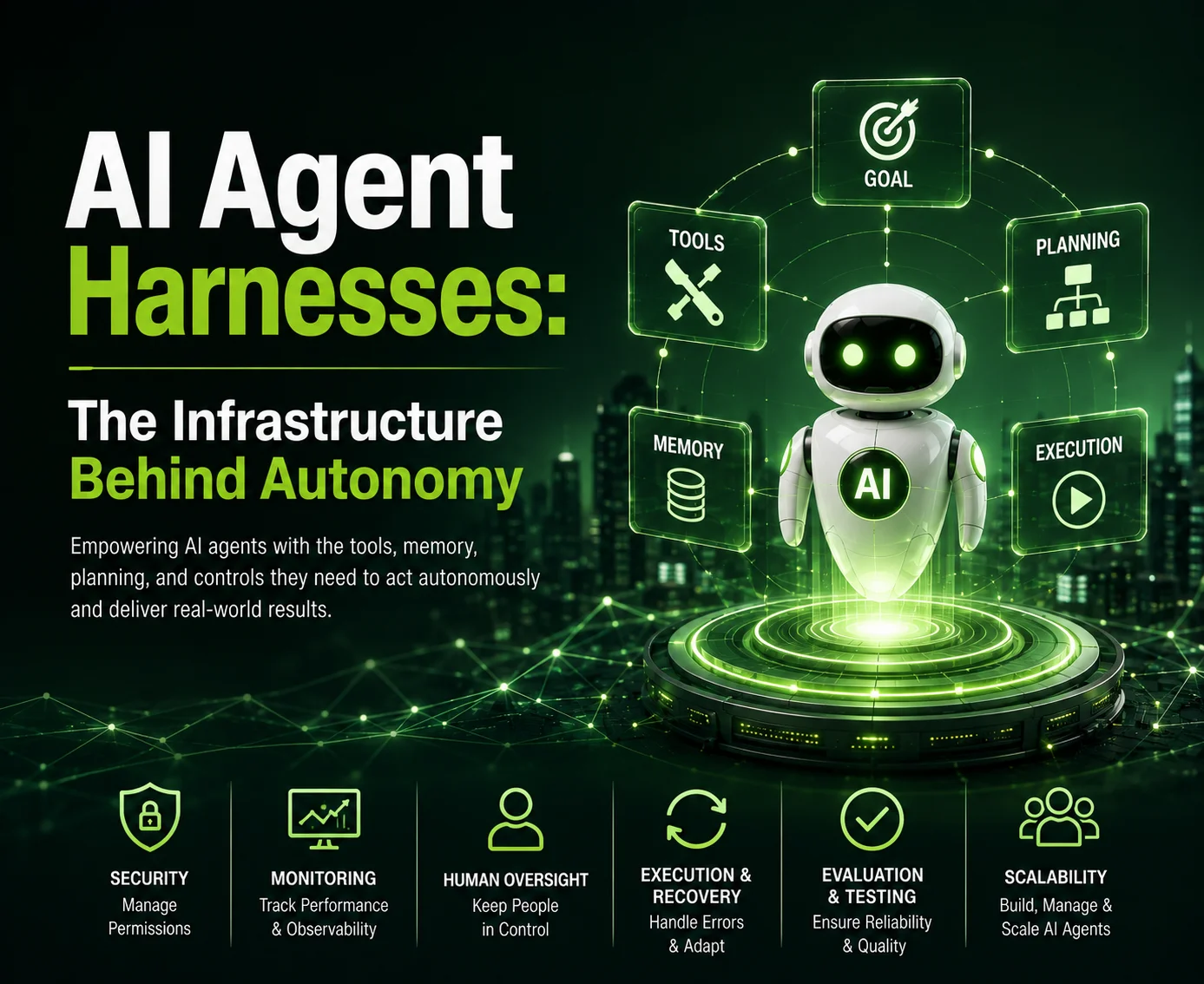
AI Agent Harnesses: The Infrastructure Behind Autonomy
AI is progressing from question-answering systems toward greater autonomy. Most traditional AI programs and applications require a human to issue a query at the beginning, and then any response will follow. In contrast, an AI agent can understand a goal, make a plan, use multiple tools, choose one tool, and perform multi-step actions until an objective is met without human assistance. This capability is typically described as AI autonomy. However, a pure AI model is generally not sufficient for practical autonomy since there must be an environment that handles the toolset, memory, its assigned tasks, permissions, and its actions toward an environment. This environment is commonly called an AI agent harness. In simple terms, an environment refers to all of the tools, tasks, memory, action that an AI agent is using to operate.
What Is an AI Agent Harness?
 An AI agent harness is essentially the environment that provides an AI agent with the tools, data, memory, processes, and controls it needs to operate, providing the agent with the data, memory, processes, and controls an agent requires to function. An office worker cannot work without a computer on their desk, programs, files, procedures, and similarly the other essential components that constitute an AI agent’s harness. The processing model is the AI model providing the agent with reasoning, and the harness provides the agent with the means of action, error handling, and task execution. Without a sufficient harness, AI models struggle with complex actions, making it essential for reliable and autonomous AI systems.
Tools: Giving Agents the Ability to Act
Tool integration is the single most important feature of an AI agent harness. A language model can generate fresh text; an autonomous agent must do far more than speak. For instance, it may have to use the internet, open documents, retrieve data, email people, run calculations, write code, or operate business systems. The harness presents an interface to external tools and the agent with a structured approach to accessing them. For example, when answering a customer, a customer service agent might first search the company database; a research agent might browse five or ten web pages and extract information. The harness helps ensure that tools are used appropriately. Tools extend the capabilities of a language model and help transform it from a text generator into an agent capable of taking action.
Memory: Helping Agents Maintain Context
Memory is another important component of AI agent infrastructure. When people work on a project, they remember previous decisions, important facts, and past conversations. A harness can store short-term memories for current tasks and long-term memories that may be useful in the future. For instance, an organization’s AI assistant can store project requirements, instructions, and frequently used information. Memory helps the agent avoid repeatedly asking the same questions or performing the same tasks. Memory must be managed carefully to avoid errors caused by outdated or irrelevant information, in order not to introduce further errors with old and useless data. The decision process as to what data should be stored, and for how long, prior to being removed and updated, needs to be considered within the design of the harness.
Planning: Turning Goals Into Smaller Tasks
Most objectives given to autonomous agents are not simple enough to be satisfied at a single instant. Agent Planning is therefore one further fundamental feature of the agent harness. As an example, an AI agent given the objective of composing a market research report would need to perform a set of actions, including obtaining data, comparing competitors, analyzing data, and composing the report. A harness can provide a structure that organizes these tasks, allowing it to perform one action, say comparing competitors, before another, say analyzing data. Harnesses can be used to register previously executed tasks, identify tasks that have not yet been executed, and plan subsequent tasks, generating methodical action plans for autonomous agents: rather than asking “What answer should I generate?”, they ask “What actions should I take?”.
Execution and Error Recovery
 When an AI agent performs several actions independently, errors can occur. A website might temporarily hang; an API might return an unexpected result; an agent might read information incorrectly. That is what execution management and error recovery are for in an agent harness: the harness can watch what is happening and check whether each action worked. If it doesn’t, the system can retry the task differently or return to an earlier step. For example, if an AI research agent can’t access one website, it can search for information from another reliable source. The harness may save the task’s current state, preventing the agent from losing progress if an unexpected error occurs.
Security and Permissions
Granting an agent access to external systems opens up major security problems. A fully autonomous agent might have access to email accounts, company documents, customer data, databases, and financial systems. If granted unlimited permissions, just one small error can lead to trouble. Managing the security and permissions of an agent is an essential part of an agent harness. The agent harness can specify exactly what the agent is (or is not) allowed to access or control. The harness may allow an agent to see the information in a customer record, but not to delete it. It may prepare an email but require a human to review and approve it before sending. These restrictions impose safety limits on autonomous agents. Good agent architecture grants permissions based on each task’s importance and potential risk.
Monitoring and Observability
 Monitoring and observability are yet another aspect of an AI agent’s harness. Even though the AI agent may operate on its own without human intervention, the managers and developers must be aware of what the system is doing. They may want to check the tools involved, how it reaches decisions, at which points the processes terminate, and where the error is. The harness can then generate this information in the form of logs, traces, and performance reports. It also makes it much easier to debug and improve an agent. For instance, if an agent repeatedly selects an expensive tool when a swifter and more cost-effective one exists, then the developers can utilize the online monitoring data to pinpoint the issue.
Human Oversight: Keeping People in Control
But greater autonomy would not always be the best way to proceed. Not every budget, every privacy-sensitive transaction, every legal question, and every enterprise-critical activity should be autonomous. An agent harness can aid human-in-the-loop oversight. The agent can run through its normal steps and suspend just before the step that involves human interaction. For example, an AI buying agent can find the best deals, prepare an order, and let a manager approve the purchase. As confidence grows, developers can gradually expand the agent’s autonomy.
Evaluation and Testing
Constant evaluation and testing are necessary for a dependable level of autonomy. An AI agent might perform a task correctly in one situation but fail in another. Developers need to run agents through many different tests. A harness should support the evaluation of accuracy, task completion, tool usage, response time, cost, and safety. Developers can prepare tests for common and unusual cases and then see how the agent performs. Also, they can compare the execution of one release of the agent with another. Testing is crucial because the agent in the application resides in a changing world. Sites, the API, data, rules, and users are all subject to modification. Testing allows verifying that the agent can always perform properly throughout its entire life cycle. Evaluation can help transform experimental agents into reliable systems.
Scaling AI Agents in Business
The importance of an agent harness grows further as organizations roll out agents in very large numbers. An organization may begin with a single agent to assist website visitors. At some point, it is not unimaginable that organizations will deploy hundreds and thousands of agents for research, software development, sales, administrative support, and data analysis. Infrastructure will be required when scheduling, resource management, communication, costs, and failures are escalated. A harness can support these functions and ensure that agents have the resources they need for execution. In a multi-agent environment, agents can collaborate, with one gathering information while another prepares or reviews the final result. We can have a multi-agent environment where different AI systems specialize in different tasks. We need some layer of infrastructure if we want to operate dozens and hundreds of autonomous agents.
Why Agent Harnesses Matter for the Future
The significance of agent harnesses will become apparent as AI capabilities develop. The first period of generative AI saw the development of many systems that produced text, images, or other types of outputs from a prompt. Autonomous agents are highly unique because they are designed as goal-seeking systems, with the potential to behave in multiple forms. That requires much more than a large language model. Agents require a safe operating environment that manages their tasks, defines their responsibilities, provides access to appropriate resources, manages memory, and supports recovery from failures. The agent harness provides that environment. This leads me to believe that future progress in AI agency might rely just as heavily on infrastructure as on modeling progress. Companies that build robust agent harnesses can equip AI agents to handle complex, real-world workflows.
Conclusion
AI agent harnesses are becoming an increasingly important building block for the future of artificial intelligence. They let the AI model transcend answering questions and start taking real-world action. Tools enable action; memory stores information; planning breaks goals into tasks; security reduces risks; and monitoring helps track and improve agent performance. As autonomous AI grows, a well-designed harness will become as important as the model’s intelligence. AI models provide the intelligence, while agent harnesses provide the structure, tools, and controls needed to turn that intelligence into useful, reliable, and responsible autonomy.

