
OpenAI Healthcare: Launches Epic Integration With ChatGPT
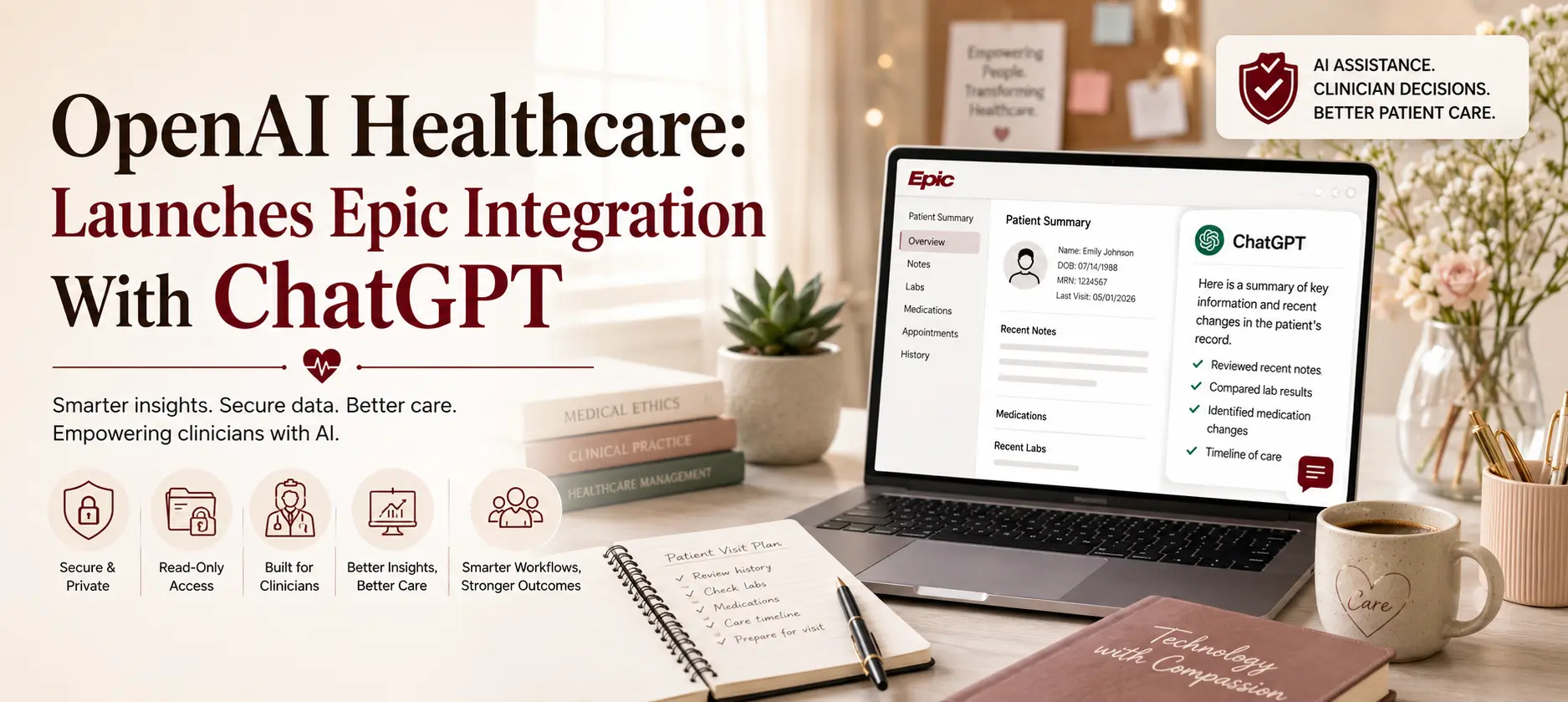
OpenAI is taking a significant step in healthcare by introducing a new integration between Epic and ChatGPT for Healthcare. The integration announced is new and enables approved healthcare organizations to connect ChatGPT with the Epic electronic health record system. Authorized clinicians will be able to use ChatGPT to help review relevant patient information, which can be extensive in EHR systems, including medical notes, test results, medications, appointments, and specialist documentation. In this new integration with Epic, clinicians could benefit from ChatGPT assisting them in combining the relevant information for patients, summarizing their history, and identifying important changes in patient information. As OpenAI noted, the integration is intended to help clinicians, not replace them, and clinicians would still make all final health care decisions.
What Is the Epic Integration?
The Epic integration connects a validated health system’s EHR with ChatGPT for Healthcare, enabling sanctioned clinicians to search within the EHR in Epic for data on patient charts (e.g., notes, labs, meds, and appointments) that is current. OpenAI states that the Epic integration supports pre-visit planning and access to relevant EHR information, and only reaches information that a clinician already has permission to access. This is read-only and may not be used to update or input information, order labs or medications, or message patients.
How ChatGPT Can Help Clinicians
The most significant benefit of the Epic connection is the prompt availability of pertinent patient data. Clinicians are likely to review information from various sections of a patient’s note before interacting with the patient. Given that charts can contain years of notes, tests, prescribed medications, and specialist recommendations, this can be time-consuming. ChatGPT may be used to synthesize the authorised information and offer a background for notable variations. The doctor will ask whether there has been significant change to the patient‘s condition, their medications, investigations, or referral. It also enables doctors to gain their own awareness before entering the consultation room, therefore allowing less time rummaging around for bits and pieces of information. According to OpenAI, the integration helps teams quickly understand patient information, giving clinicians more time for patient care.
Supporting Better Patient Preparation
 Getting ready for a patient visit may often require sifting through previous notes, labs, meds, specialist entries, and so on. ChatGPT Epic integration may allow for an additional convenience for clinicians, as it can bring together these pieces of data. For instance, clinicians can ask ChatGPT to identify recent lab results, compare lab results with those from a previous visit, and provide a clinical timeline based on authorized patient records. This can be helpful for care teams to get a better sense of the patient and the flow of care so they don‘t have to sift through reams of information. However, ChatGPT doesn‘t make final medical decisions. It remains the clinician‘s responsibility to review the source documents and determine what information is pertinent to the patient.
ChatGPT Can Work Within Healthcare Systems
OpenAI’s statement also discusses two potential ways the new technology might improve a healthcare workflow. In one use case, authorized patient information from an electronic health record can be accessed and reviewed through ChatGPT. This helps doctors understand patients and prepare for visits. ChatGPT can also work within supported EHR workflows. This might enable clinicians using existing digital tools in their daily work to do so without constantly switching between different programs. OpenAI hopes these integrated AI tools will make healthcare data more useful without disrupting existing permissions and controls.
Privacy and Patient Data Protection
It is clear from the sensitivity of patient information that the issue of security and confidentiality of records using AI needs to be a high priority. According to OpenAI, organizations should use the integration within authorized clinical workspaces. Each clinician must connect their own Epic account, and the integration does not provide access beyond the permissions the clinician already has in Epic. OpenAI states that organizations must complete prior authorization and configuration before accessing patient data. Organizations must have the proper agreements, authorizations, and settings in place before they can access patient data with the use of the integration. This means it will not perform write operations against the medical record. These types of controls empower organizations to implement AI under good privacy, security, governance, and compliance policies.
A Read-Only Approach
Another aspect of the Epic integration is that it is read-only. This allows clinicians to see the information they have clearance for. They cannot write or modify the record through this interface. This interface is capable of retrieving information regarding medications, allergies, problems, conditions, labs, notes, and past visits. It is not capable of writing to the chart, sending orders, or sending messages to patients. This is an important safety feature because it keeps responsibility for the patient chart with the clinician. The instructions to clinicians are to double-check the original record to confirm the information.
Healthcare Public Data Plugin
At the same time OpenAI released an Epic integration, they also released a ChatGPT and Codex Healthcare Public Data plugin. This offers healthcare teams structured data from public healthcare sources. According to OpenAI, the sources being used are PubMed, DailyMed, CMS Coverage, and other primary datasets. This can be useful when clinicians need to reference information that is not directly available in a patient’s medical record. For example, outreach program teams may need research articles, clinical trials, federal drug labeling data, and Centers for Medicare and Medicaid Services coverage information. Bringing in these public sources of data can enable users to work with different types of healthcare data within a single governed environment. It can also be seen that the public data plugin is distinctly separate from the Epic integration. Epic will provide access to authorized patient record data. Healthcare Public Data provides a different set of information from publicly available sources.
Testing ChatGPT for Healthcare Work
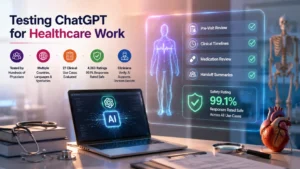 AI systems need to be tested with care before they are deployed into critical healthcare settings. OpenAI states that it tested ChatGPT with physicians from many different countries, languages, and specialties to evaluate health pre-visit responses. OpenAI also evaluated ChatGPT with physicians across 27 clinical use cases, including pre-visit review, clinical timelines, medication review, and handoff summaries, and clinicians rated ChatGPT’s outputs as 99.1% safe across 4,363 ratings. However, a high safety rating does not prove AI should take over from doctors. Information in medicine can be complex, and a tiny mistake can have a big consequence. Clinicians will have to confirm that information produced by AI matches the source record before using it for the patient.
Benefits for Healthcare Organizations
The Epic integration offers several potential benefits for hospitals, clinics, researchers, and administrative systems. First, it could save clinicians time when reviewing lengthy patient notes. Second, it could summarize clinical information in an easily digestible format. Finally, it could help clinicians review appointment-related information and prepare for clinical handoffs by bringing relevant information together. There are also administrative teams in healthcare organizations that could potentially use AI-enhanced workflows. OpenAI has created ChatGPT for Healthcare, which would help clinicians, researchers, and healthcare administrators directly. The OpenAI team has promised that patient records would be protected in a single sign-on, role-based access system, and records of use would be maintained.
What This Means for the Future
This Epic integration illustrates how AI is getting closer to real healthcare processes. It is no longer just a generic chatbot; healthcare professionals could link ChatGPT to approved health systems and data sources. This has the potential to revolutionize the way healthcare experts seek, appraise, and combine information. Nevertheless, when developing these applications, developers need to pay the utmost attention to accuracy, privacy, security, consent, and reasons for its use. OpenAI’s implementation currently respects clinicians as the final decision-makers and limits the Epic connection to read-only mode. As healthcare organizations develop use cases, AI could become a helpful assistant for information and administrative tasks. This might free up clinicians and other caregivers to devote more time and attention to patients.
Conclusion
OpenAI’s new Epic integration represents a positive development for OpenAI Healthcare by connecting ChatGPT to authorized patient information stored in an organization’s Epic EHR. It may help providers to evaluate notes, summarize medical data, identify trends, and support appointment preparation and patient visits. In parallel, OpenAI has implemented limits to promote safe deployment. The Epic connector is read-only, inherits existing permissions, and does not allow ChatGPT to alter charts or make final clinical decisions. Together, the Epic integration and Healthcare Public Data plugin demonstrate potential paths to integration of AI into existing workflows at healthcare organizations. AI would not replace clinicians; instead, clinicians could use AI to analyze large amounts of information more efficiently while protecting patient data and using the technology responsibly.

