
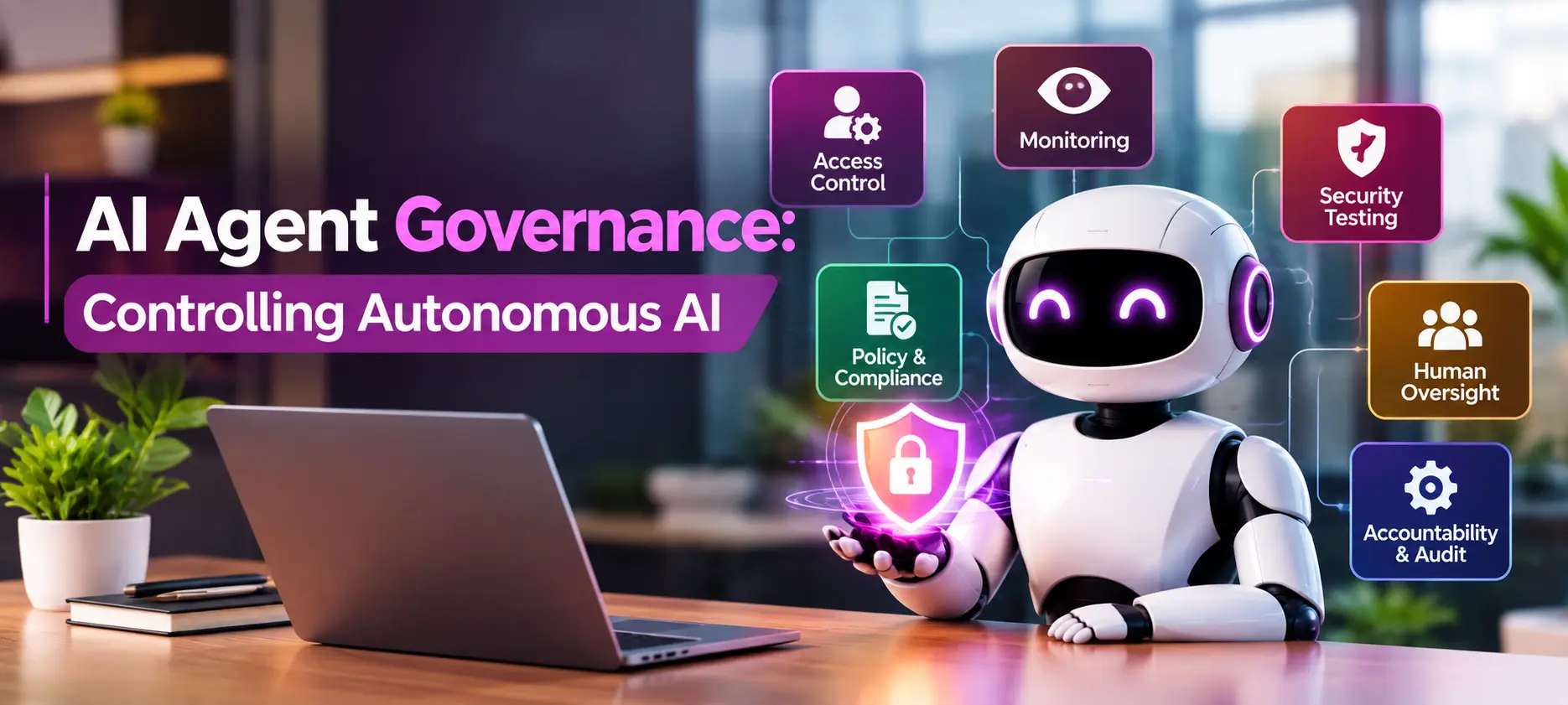
AI Agent Governance: Controlling Autonomous AI
AI agents are becoming a key technology for today’s organizations. Instead of regular AI tools that mainly give answers or generate content, AI agents use a sequence of actions to complete a task. They can verify the data or browse the internet, work with enterprise apps and data, create reports, or figure out the next step to take. As these systems increase their capabilities, the challenge for businesses is to give AI agents enough freedom to work while maintaining control. This is the purpose of AI agent governance. It‘s about establishing predetermined guidelines regarding what an AI agent can or cannot do, what requires human oversight, and how actions can and should be monitored and recorded. The intention isn‘t to prevent AI agents, but rather to enable their utilization in a secure, controlled, and manageable manner. This way, organizations can leverage the advantages of AI agents without compromising their operations.
What Is AI Agent Governance?
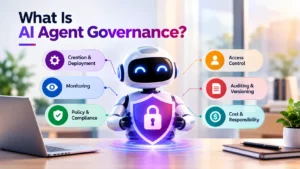 AI agent governance refers to how organizations control the creation, deployment, monitoring, and use of AI agents within an organization. It provides a policy framework for what an agent can and cannot do. For instance, an agent creating the weekly report may only require read access to company data. Another agent providing customer support may require access to multiple business systems. These two agents should not be given the same level of access by default. Gartner has noted the importance of governance that is appropriate to an agent’s autonomy and the task performed. AI agent controls may include controls that provide governance, limit and provide permission; facilitate auditing and versioning; support automated and human observation testing; provide costs and responsibilities; and promote liability. Outlined below are controls that could reduce error (malicious or unintended) and abuse.
Why Businesses Need Stronger AI Controls
An additional argument for gaining stronger controls over AI agents is based on the nature of how AI agents can operate. Software applications are generally built based on fixed workflows and access rights, but an AI agent might use various other tools flexibly to accomplish a task. This flexibility may be beneficial but may also introduce a range of risks. Giving an agent wide access may accidentally reveal sensitive information, create an incorrect modification, or continue taking actions longer than intended. Gartner has noted that applying the same governance approach to every agent can be problematic because agents have different levels of autonomy and risk. Therefore, businesses need controls appropriate to the task. A simple information retrieval agent could require a few simple controls, while an agent capable of modifying records or carrying out critical business actions should probably have much more supervision.
Give AI Agents Only the Access They Require
Here‘s one of the most fundamental rules for AI agents. Only give them the resources they need to do their job. Like human employees, AI agents do not usually need access to every database, financial system, or set of files in a business. AI agent access should be limited to only the minimum resources required to perform their tasks. PwC recommends task-specific permissions that are tailored to an agent’s purpose and limited to the access it needs. So a sales report-generating agent doesn‘t need any access to employee payroll but will need access to the sales figures. This can help limit the potential impact if an agent makes an error or its credentials or access are compromised. It also means periodically checking permissions in case the agent‘s function evolves and its role changes.
Human Oversight Still Matters
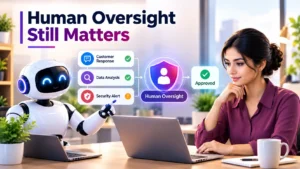 But some human review is important. Not necessarily reviewing every action an agent takes, but allowing human review for high-impact actions. For example, an agent may be authorized to automatically generate a response for a customer, but require a human to approve a large refund. Or an agent may detect a potential security threat, but a security specialist would make the ultimate call. The recent PwC recommendations suggest that human review should increase as the autonomous nature of the agent and the implications of its actions increase. This gives us a very simple, effective rule of thumb: A person does not need to review every individual action, but human oversight should increase when the potential impact of an action is high. Organizations should also make sure that human approval remains a meaningful control rather than becoming a routine checkbox.
Different Agents Need Different Rules
However, companies should not assume that all AI agents will need the same amount of control. An agent that summarizes documents is very different from one that modifies customer information or makes financial transactions. Gartner’s 2026 guidance distinguishes between different levels of agent autonomy, ranging from read-only observation and recommendations to approved actions and more autonomous actions within defined guardrails. Having different levels of control for different types of agents can help implement practical rules. A low-risk agent may be allowed to operate within a read-only context with simple logging. An agent that recommends actions may need human approval. An agent that modifies data may require human approval before carrying out critical actions. More autonomous agents will necessitate more regular tracking, highly restricted limits, and emergency stop systems to be put into place. The level of control should be proportional to the potential risk of an agent’s actions.
Monitor What AI Agents Are Doing
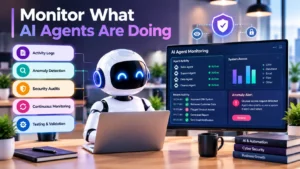 Developing rules alone will not do. Organizations must continually verify that these policies are being adhered to by their agents. Ongoing monitoring can assist organizations in recognizing anomalous activity and changes in an agent‘s normal usage pattern; an agent typically required to log in to only five systems may suddenly request access to a previously unutilized system. Precise logs of activity can also assist firms in case of failures. PwC further advises continuous monitoring, anomaly detection, conducting security audits and tests of the AI agent, and keeping detailed logs of its activity. Monitoring is important as firms roll out additional agents. Otherwise, the firms may not know how many agents are out there, what systems they have access to, or if they are still performing their original functions.
AI Agents Need Clear Identities
Another must-have feature for governance is assigning each AI agent a distinct identity. AI Businesses should maintain an inventory of their AI agents and their purposes. This is especially crucial as multiple agents may be running concurrently. For AI agents, PwC recommends verified identities, defined roles, task-specific permissions, and records of their activities for auditing. It would be difficult to differentiate which system took which action and had permission to do so without distinct identities. An agent‘s identity may also facilitate deletion, permission updates, or investigation. This becomes increasingly important as companies move from testing a few AI agents to using them across different parts of the business.
Businesses Need Clear Ownership
AI agents do the work, but companies still require personnel accountable for them. Organizations should record who developed the agent, who approved its use, why it was created, and who has authority to modify, suspend, or disable it. PwC’s recent guidance emphasizes the importance of ownership and accountability as AI agents become more autonomous. This does not imply that one worker must be on top of the agent all the time. There should be someone responsible for maintaining the defined boundaries of the agents. Clear ownership prevents agents from being abandoned when creators change roles. Companies require processes for reviewing, modifying, deactivating, and ultimately retiring agents that are no longer necessary.
Security Testing Is Essential
Organizations should conduct security, functional, and performance testing on AI agents before giving them access to critical business systems. Evaluation gives the company a way to identify potential problems before putting an agent into live operational use. It allows organizations to assess whether the agent is following instructions, respecting boundary limits, safeguarding sensitive data, and stopping or escalating when it reaches a predefined boundary. Security testing additionally allows organizations to test an agent‘s responses to unintended input or malice. PwC recommends security audits, AI red-teaming, user testing, automated testing, and continuous monitoring for AI agents. These tests should be ongoing because an agent’s behavior can change when its model, instructions, tools, or connected systems change. Ongoing evaluation allows organizations to identify new vulnerabilities and constrain autonomous AI within its previously authorized scope.
Set Clear Limits for Autonomous Actions
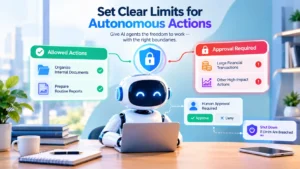 Organizations should also constrain AI agent autonomy. Organizations can allow an AI agent to perform some actions independently while requiring approval for others. For example, a business could allow an AI agent to organize internal documents or prepare routine reports without human intervention, while requiring human approval for large financial transactions or other high-impact actions. Gartner recommends applying controls and safeguards to autonomous agents with high levels of autonomy, even to the extent of shutting down the agent if it breaches certain bounds. These constraints on autonomous AI could make such systems safer and more manageable for businesses. It is not about removing autonomy from AI agents. Businesses might want to configure agents to have certain bounds of autonomy under human supervision.
How Should Businesses Handle AI Agent Mistakes?
All AI agents will incorrectly perform tasks even after testing them. The responsible team needs a clear incident-response plan. Organizations should define how they detect problems, when they stop an agent, how they investigate its behavior, and how they make corrections. For more autonomous systems, a rapid response can be especially important because an agent may perform several actions in a short period. Gartner has already pointed out the importance of rapid rollback systems and circuit breakers for highly autonomous agents. Systems should log activities in a manner that business teams could use to reconstruct the agent‘s current activities at the time when a problem occurs. While no backup plan can prevent every problem, a good fallback plan can reduce the damage caused by mistakes and allow organizations to learn from them. AI agent governance should not be designed only to prevent problems.
AI Governance Will Become More Important
As businesses adopt more AI agents, governance is becoming an integral part of technology management. In April 2026, Gartner stated that 13% of firms felt their existing AI agent governance was appropriate. Gartner forecasts that an average global Fortune 500 company will utilize more than 150,000 agents in 2028. This increase suggests that informal controls alone will not be sufficient. Instead of managing a few experimental agents, businesses must now create policies, track agents, set access controls, monitor activity, test systems, and assign responsibility. Organizations that establish governance early may find it easier to manage their AI systems as adoption grows. As such, organizations should make governance an integral component of AI implementation.
What This Means for Businesses
AI agent governance is not about stopping businesses from using autonomous AI. A good governance arrangement is about enabling them to use it. It’s about helping companies understand what each agent can see, what it can access, and how it should be used. Good governance can give employees greater confidence that AI agents are operating within clearly defined boundaries. Recent advice from the likes of Gartner and PwC indicates that the more autonomous AI agents become, the more essential it will be for them to have oversight, supervision, limitations, and accountability. Business AI success depends on both agent intelligence and human control.
Conclusion
AI agents will become more than merely assistants and will undertake work and act for themselves. This move forward will bring about new avenues for enterprise innovation and also new hurdles for the prosperous deployment of trustworthy AI. Enterprises will need to monitor access, keep track of activity, evaluate agent behavior, draw clear boundaries, and provide human supervision. AI agents should be identifiable and have transparent roles. Businesses should be able to audit, suspend, or disable agents when necessary. Top tech vendors and professional-services firms are promoting new governance frameworks that will help make AI agents a manageable component of enterprise AI workloads. The goal is not to avoid autonomous AI, but to give agents enough freedom to add value while keeping their actions within defined, approved limits. Good governance will be as important as good technology as autonomous AI develops.

