
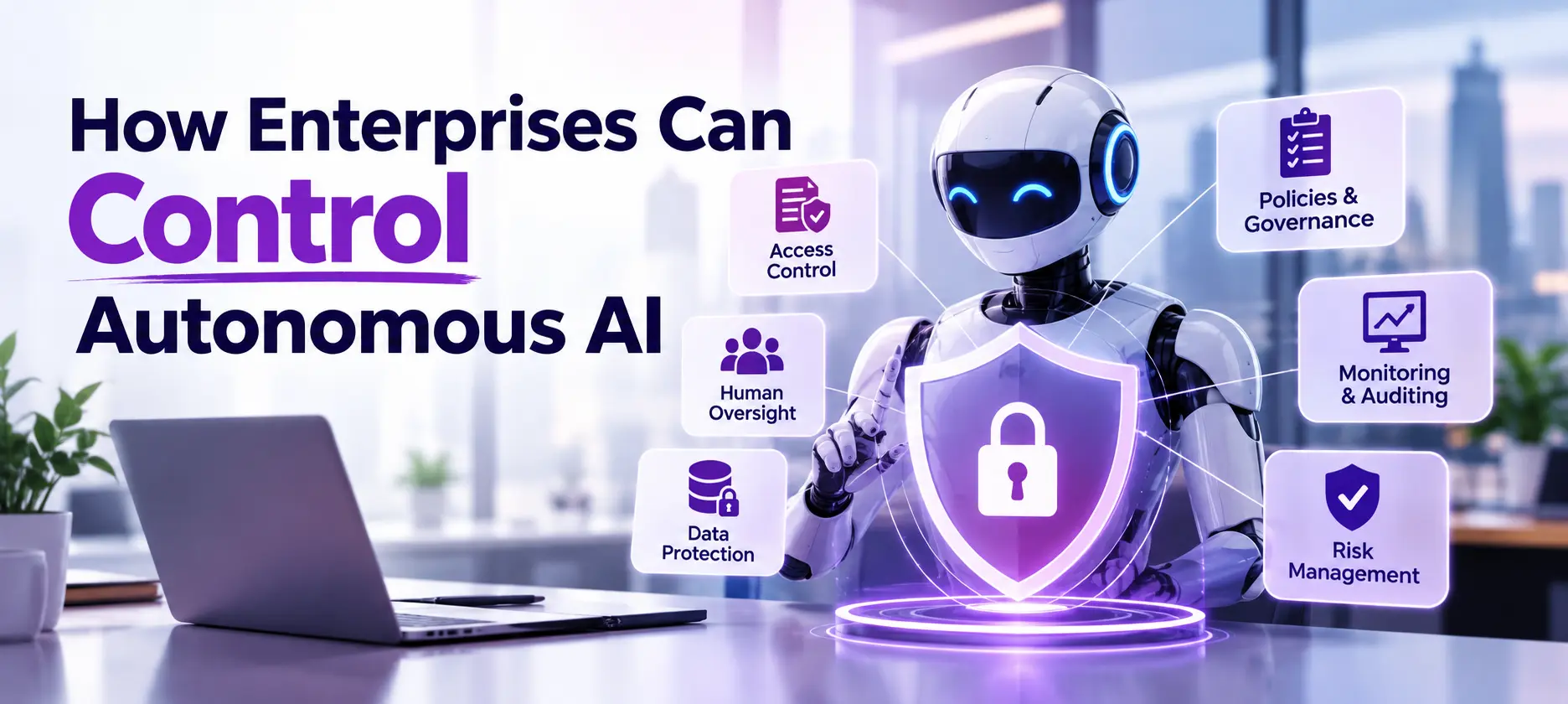
How Enterprises Can Control Autonomous AI
Artificial intelligence can do more than chatbots and content tools. In fact, many businesses already have AI-enabled machines that can decide, work, use software, and can do many tasks without humans having to always do anything during those processes. This is an autonomous AI. This can save time for employees, enhance efficiency, and help in many business processes. But more self-governance can lead to new challenges. A system can make a wrong decision, use sensitive data, or take actions that can cause serious problems for the enterprise. Therefore, enterprises need good governance in place before such autonomous AI systems are deployed with mission-critical systems, but there is no need for enterprises to cease using autonomous AI. Instead, they need to establish policies that allow such AI systems to operate under human control.
What Is Autonomous AI?
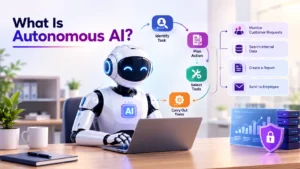 An autonomous system would contain an AI that can carry out these tasks to the degree of human input desired. It can go far beyond a simple question-answering system. It can not only identify a task, but plan a course of action, select tools, and carry them out. For instance, a company could use an autonomous AI system that will keep an eye on customers’ requests, search internal business data for information, create a report, and send the report to one of its employees. Such intelligent systems can communicate with the business application and decide based on dynamic scenarios. This makes the simple chatbot far more intelligent, but also puts the AI in a position to impact the business processes. Humans removing too many restrictions may make the AI system have a little misstep snowball into a major problem. Enterprises must control the view, decision, and action properly.
Why Enterprises Need AI Controls
Enterprises are not able to ‘treat’ autonomous AI like the run-of-the-mill software because, in addition to being able to assume a preprogrammed course, autonomous AI can also adapt by taking actions in changing circumstances. Conventional (non-autonomous) software relies on being able to perform in accordance with fixed rules and instructions. A combination of new information, wrong data, an anomalous outcome, or unintended reflection of sensitive information is more likely when AI is given even broad access to financial systems, customer data, etc. Enterprises require standards for controlling autonomous AI; companies need limits on the possible actions.
Give AI Only the Access It Needs
One of the most important methods of controlling autonomous AI is to restrict its access. An enterprise should grant an autonomous system only the access to information, applications, and permissions that it needs. For instance, if the AI system writes sales reports, the system would need access to sales data but wouldn‘t need access to HR records or financial information. Enterprises can separate these by role-based access controls and other access policies; thus, in case of a mistake or malicious use, the potential damage can be reduced. Enterprises should also continuously review the access privileges because the access privileges can grow over time. Removing those excess access privileges can keep the autonomous AI system operating in a limited scope. In basic language, enterprises should adopt the principle of least privilege for autonomous AI.
Set Clear Rules for AI Actions
Enterprises should state clearly the functions and actions that an autonomous system is allowed to perform. For example, rules may define whether an autonomous system can access, change, transfer, update, transmit, command, or purchase data. For instance, one autonomous system could generate a refund recommendation but require an employee to approve the refund. Another autonomous system could generate a customer email but require a human to approve it before sending. Strict rules delineate lower-risk from higher-risk tasks. Enterprises can also create a system of permissions for multiple autonomous systems. For instance, if an autonomous system is performing a lot of protected administrative tasks, it might have more latitude than an autonomous system that handles sensitive financial information. Once established based on preset criteria, the enterprise can contain its high-value autonomous system within its pre-established operating domain.
Keep Humans Involved in Important Decisions
The need for human review even when the system is working on its own is still a concern. Businesses need to decide what actions humans should supervise before the AI implements them. This could be financial transactions, legal decisions, changes to customers, security changes, or access to sensitive information, among others. Human review does not mean that employees will constantly examine every tiny action an AI takes. This allows us to have the AI make reasonable or risky choices, while human experts handle the mundane tasks. There can be emergency stop features to prevent the AI from deciding until it is given the go-ahead by a human employee. Businesses can enjoy the benefits of autonomous AI by having the automation checked and supervised rather than just having the AI make all the decisions.
Monitor Autonomous AI Continuously
An enterprise should monitor autonomous AI after deploying it rather than just hoping the AI will do what is expected of it. Monitoring will give the enterprise an indication of what database systems the AI was accessing, what actions it was taking, and whether its behavior was changing. Log files and monitoring can help identify unusual behavior within the AI. For example, if an AI accessing only two systems in a business suddenly accesses a third system, this could flag an issue with the configuration, a security breach, or unusual behavior by the AI. Monitoring can help businesses detect if the system is getting its job right. Regular monitoring gives security and AI technology teams useful information about how the AI behaves in normal operating conditions. An enterprise learning about a problem only after it has caused damage has missed an important window of opportunity.
Test AI Before Giving It More Freedom
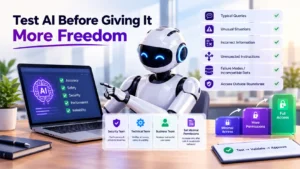 Enterprises should test autonomous AI before deploying it on an important business task. Testing can check how the system responds to typical queries, unusual situations, incorrect information, and unexpected instructions. Businesses should also test how the system handles failure modes or supplying incompatible information. Security teams can test whether the system can access information outside its boundaries. Technical teams can verify the accuracy, safety, security, and stable operation of the system. Enterprise permission levels should initially be minimal and only increased once the system is shown to exhibit safe, predictable behavior. This detailed step-by-step approach reduces the danger: AI need not be connected everywhere straightaway. Putting it through its paces, sooner or later reveals its weak spots, before any customers, staff, or even the firm itself suffers.
Create an AI Governance Policy
An enterprise requires not just technical controls on autonomous AI, but also an overarching AI governance policy. Such a policy should clarify who is authorized to deploy AI systems, usage restrictions on such systems, allowable scope of AI actions, responsible ownership, and reporting lines in case of an anomaly or failure. This policy should also identify the process for managing AI-related issues and define the responsibilities for handling such issues. As the requirements may vary across departments, it is prudent for enterprises to define policies suited to the risk levels of individual use cases, with inputs from legal, security, technology, and business teams. An effective governance system helps give direction to the employees and does not throw all AI decisions to teams.
Protect Sensitive Business Data
Autonomous AI frequently requires access to company data; therefore, enterprises must monitor precisely what data they permit AI to utilize. An AI system may have access to sensitive data such as customer information, employee data, financial information, business knowledge and other sensitive data. The firm must enable an AI only to access data to which it should have access and implement controls to limit it to using only the data needed. Businesses should log data access to help detect and diagnose accidental data leaks. Moreover, businesses should understand how the AI system stores and handles data before connecting it to sensitive business information.
Create an Emergency Stop
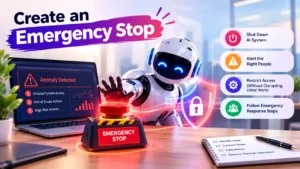 Enterprises want the ability to turn off an autonomous AI system that goes wrong. Emergency stops are very much more critical when an AI is connected to business-critical systems: “If the monitoring system tells us the AI is behaving outside of the expected parameters, the business can then disable the system or, for the short term, disable access,” he said. Employees would need to know who to call and what to do. Businesses can also have controls that isolate the system that grants AI access while not disrupting other business activities. An emergency stop does not mean that an AI system will always result in failure, but it provides a way for enterprises to respond when something unexpected happens.
Keep AI Actions Auditable
Enterprises need visibility into the actions performed by autonomous AI systems. Enterprises should keep detailed logs of AI actions, including accessed data, tools used, decisions made, and actions taken. The audit logs are useful in investigations in case of any issues and can also form part of security investigations or internal review processes. Enterprises need to weigh the need for monitoring with the need for privacy and data protection. The intent here is not to generate too much information, but to ensure sufficient visibility of key AI activities to review and evaluate the autonomous AI in operation.
Train Employees to Work With AI
Technology by itself isn‘t enough to keep autonomous AI out of trouble. This is why workers need to understand how the systems operate and where their boundaries are. Operators should be aware of potential failures in AIs (errors, misinterpreted instructions, or the generation of false data). They also need to comprehend when they should re-evaluate an AI decision or report suspicious behavior. Personnel operating AIs require even more training (additional access, computer security, incident management). With proper training, workers would not need to give AIs too many access privileges or blindly trust them. A simple problem reporting procedure ought to be in place. Once enterprises recognize how operators fit into the institution’s AI safety controls, they will become a critical human element that might help businesses catch errors that automated controls could overlook.
Start Small and Expand Carefully
 Enterprises need not give an autonomous AI complete freedom from inception. They can take risk-mitigating incremental steps. Start with a constrained task, verify reliability, and delegate low-risk actions for human review and approval. A company could begin with an AI that merely searches for information and collates recommendations for review and approval. A company can then review performance and allow a semi-autonomous AI to perform simple, low-risk actions in a controlled fashion before providing it with increasingly complex autonomous functions. This allows the company to learn exactly how the AI works with less risk and rectify any mistakes before then giving the system more and more freedom.
What Happens When Autonomous AI Makes a Mistake?
No matter how theoretically well planned the control system is, it’s also possible for the AI system to be wrong. The key question is how quickly any company can identify and respond to the problem. Businesses should establish in advance and in detail a response plan in case of an AI error in a business-critical process so staff are ready to disable that process in order to investigate the problem, rectify it, and recover a controlled state of operation. Businesses should review and update their controls after the event, as required (for instance, if an AI system gained access to data out of scope, resources or rules would need updating). Incidents provide valuable lessons for improving future AI implementations. A specific targeted response can turn an AI error into a positive, improving the company’s overall AI management systems.
The Future of Enterprise AI Control
Autonomous AI will become more beneficial as enterprises begin to connect it to more business tasks and flows. This gives businesses time by making boring tasks automatic, so they have to do and respond more quickly to problems. But they should find a balance between preserving control and giving AI freedom. Giving AI free rein would cause too many risks, and restricting the AI too much would remove the majority of the benefit. The optimal approach would be controlled autonomy. Enterprises should implement limited access, rules and policies, human intervention, continuous monitoring, testing, auditing, and fallback mechanisms. These components would enable AI to deliver value while maintaining the edge over enterprise decision-making. As autonomous AI becomes widely adopted, good enterprise governance would become a critical element in responsible AI.
Conclusion
However, enterprises ought not to hand over AI autonomy just because it is able to work independently. Organizations must establish boundaries for AI access, actions, and human review. Enterprises should also restrict AI activity, test the systems, protect sensitive data, log AI actions, and maintain an incident response plan. Beginning with low-risk, simple activities might give enterprises proper confidence for further AI risk. Controlled autonomy is the goal: the AI can work independently within clearly defined parameters and controls. If the controls are in place, the enterprise can roll out autonomous AI more safely while establishing human accountability and responsibility.

