
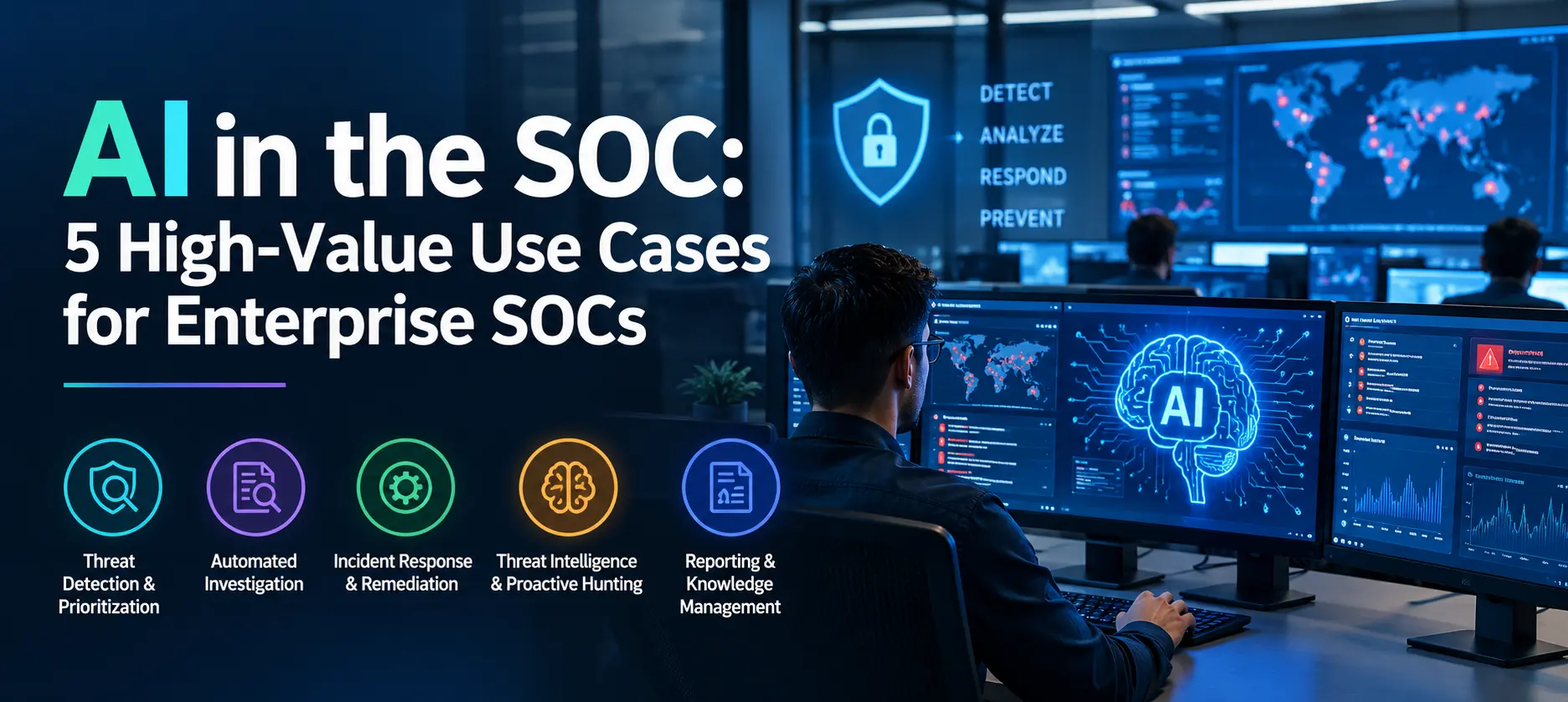
AI in the SOC: 5 High-Value Use Cases for Enterprise SOCs
Artificial intelligence is revolutionizing the modern enterprise space, and the global surge of sophisticated cybercrime is one of the main factors influencing the rising demand for AI-driven solutions in cybersecurity. While security operations centers (SOCs) generate thousands of security-related events every day, having the right set of tools at one’s disposal is no longer enough – enterprises need both the resources and the know-how to sift through the data, identify relevant insights, and take appropriate action based on those insights.
By introducing AI to the SOC, enterprises enable their security teams to do exactly that: detect and prioritize threats based on their level of urgency and relevance, respond swiftly and confidently, and stay ahead of emerging risks by learning from past events and adjusting their defenses accordingly. In short, AI empowers security teams with the critical reasoning capabilities needed to succeed in today’s threat environment while eliminating much of the busywork typically associated with SOC operations.
While AI is not capable of replacing human security analysts, understanding its potential applications is a crucial step toward maximizing the output of an enterprise SOC. This article will discuss five important use cases of artificial intelligence in enterprise SOCs. The above-mentioned article will explore five different use cases of AI in enterprise security operations centers. We will examine the possibilities offered by each solution, as well as the ways in which enterprises can leverage those opportunities to transform their SOC operations for the better.
What Is AI in the SOC?
AI in the SOC involves applying artificial intelligence technologies to investigate and monitor computer security, detect threats and incidents, conduct research and analysis, and respond to events. Such technologies as machine learning, generative artificial intelligence (AI), natural language processing, and intelligent automation are used in the security operation centers (SOCs) of enterprises to ensure cybersecurity.
To improve SOC performance, enterprises should consider numerous electronic actions and decisions. They originate from different sources, including endpoints, networks, clouds, identity platforms, and security technologies. The manual analysis and correlation of such data is challenging and requires experts’ time and effort.
In this setting, AI can help to process high volumes of data, identify patterns and behaviors, and suggest relevant security events for further investigation. By integrating such technologies into SOCs and operating them with technologies like security information and event management (SIEM), endpoint detection and response (EDR), and security orchestration, automation, and response (SOAR), enterprises can benefit from their capabilities.
1. AI-Powered Threat Detection and Alert Prioritization
Threat detection is one of the important uses of AI in the SOC. Large companies create thousands of alerts every day. Many of these are not real threats. They are mistakes that take up the time of SOC analysts. This is a problem; it’s not possible to look at every alert. It doesn’t make sense to only pay attention to the ones that seem important. That is where AI is useful; it can help analysts find activities and make sure they focus on the right things.
How It Works
Machine learning models can learn to recognize patterns associated with malicious activity in the system. Examples of such patterns are events of risky file access, network connectivity, and unauthorized or anomalous data transfers.
For instance, machine learning can analyze information about the files being opened, alerting about violating activities. Suppose there is an employee who, during their shift, opens highly confidential data concerning the company’s intellectual property. In that case, the algorithm can raise a red flag. Additionally, information about the same user’s authentication, unrelated to work hours, and significant data downloads can be linked and raised as an alert.
The data mining approach using machine learning techniques can be applied to provide additional information about users, such as privileges, asset importance, and threats, along with relevant events and incidents.
Key Benefits
The use of AI to detect incidents can reduce the number of false positives in enterprises, as well as the associated alert fatigue. On the one hand, AI can analyze data patterns that a human security analyst would not think of investigating. In addition, AI can help organize and prioritize security incidents by risk.
On the other hand, organizations using AI security solutions must carefully review the detected incidents. The reason is that many AI risk scores may turn out to be incorrect, and important problems may be downprioritized as false positives.
2. Automated Security Incident Investigation
Investigating security incidents can take hours for an analyst. One suspicious event might need the analyst to look at endpoint logs, authentication records, network traffic, and threat intelligence from systems. Investigating security incidents can be helped by AI, which gathers evidence, links related events, and shows findings in a clear way.
How AI Supports Investigations
AI-driven tools can perform correlation of security events and produce summaries of anomalous incidents. In addition, generative AI can assist analysts in querying large information repositories using natural language.
For instance, a security analyst can ask how a malware infection on a particular employee’s PC happened. The SOC team needs to clarify how the infection happened, what the malware’s impact was, and whether other devices were compromised.
An AI investigation assistant can advise which process was anomalous, analyze network traffic, review the login history, and scan for similar processes across the enterprise. It can also present the information in a timeline and recommend next steps.
Why It Matters
Automated investigation support allows analysts to reduce the time spent on research activities. In addition, it helps less experienced team members to follow established investigation procedures. For an enterprise Security Operations Center (SOC), the value of automated investigation support includes reducing the time of response to incidents and thereby enabling more experienced analysts to focus their efforts on complex cases.
However, in either case, research results must be consistent with the data available to the analyst. Thus, incorrect AI-assisted conclusions may lead to false negatives or, conversely, to business disruptions caused by inappropriate responses. For this reason, special attention must be paid to protecting sensitive information resulting from investigations, analyses, and assessments.
3. AI-Driven Incident Response and Remediation
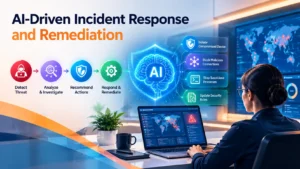 Detecting a cyberattack is only half the battle. You also have to deal with the damage and neutralize the threat, so organizations have to know not only what to do but also how to react to an ongoing attack.
The old-school method of incident response is to cut off the hacked devices from the network, delete illegal server connections, and kill suspicious processes. But that takes time, during which the cybercriminals can get away with data theft or financial fraud. The use of AI can speed up the process and recommend certain steps to the SOC team to speed up the process and neutralize the cyberattack as soon as possible.
How AI Improves Response
AI can investigate incidents, determine likely attack types, and recommend response actions. When integrated with SOAR tools, it can suggest executing specific workflows based on the organization’s plays.
For instance, an AI-driven investigation can analyze endpoint events, gather evidence, identify network activity associated with detected malware, notify analysts, and recommend isolating the compromised endpoint.
Accordingly, certain automated procedures can be taken based on the playbooks developed by the organization. If the action requires little risk, it can be performed automatically, and if it involves significant changes, it must be approved by an analyst.
Benefits for Enterprise Security
Artificial Intelligence response can reduce the workload while also standardizing and accelerating the process of containment. Automation can document the response by recording all actions performed. The problem with total automation is that any incorrect action taken to disable an important account or network segment can disrupt business operations. Companies must implement approvals, rollbacks, and escalations before response automation if it has to manage vital actions like isolating a business-critical server.
4. AI-Powered Threat Intelligence and Proactive Hunting
Threat intelligence is the ability of security teams to keep up to date on evolving attacks, attack infrastructure, and tactics used by adversaries. However, there is a lot of information to track down and analyze, which comes from various sources such as security vendors, industry reports, government agencies, and past incident investigations.
This can take a lot of effort to track down, analyze, filter, and apply. That’s where AI comes in, by distilling massive amounts of threat intelligence data into meaningful security insights.
Improving Threat Intelligence Analysis
AI can find signs of a security breach, spot details about malware, summarize attack reports, and link threat data to past security events.
For example, a report might say attackers used stolen login details to get into cloud apps and move data. An AI-assisted SOC can quickly scan the company’s logs for login behavior, strange app access, or unusual data transfers. This helps analysts check if the same kind of activity is happening in their systems.
Supporting Proactive Threat Hunting
I see how threat hunting means looking for activity that automatic detection systems might miss. AI can help threat hunters by spotting behavior, creating investigation ideas, and linking events that look unrelated. AI can also help security professionals look into attack methods and search past records for useful clues. These abilities make threat hunting faster and more thorough. Still, AI ideas must be checked against facts. Threat intelligence must also be confirmed before companies block connections or start actions.
5. AI-Assisted Reporting and SOC Knowledge Management
Security analysts must brief various stakeholders, including technical teams, executive management, compliance departments, and business owners, about security incidents. It may take a lot of effort and time to prepare reports since the incidents often involve numerous systems and substantial evidence.
By using AI, security analysts can save much time on reporting and briefing due to its capacity to summarize investigation results and present the key points in an understandable manner.
Automating Security Documentation
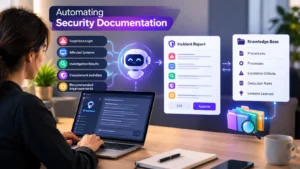 Generative AI can help security teams produce incident reports that outline the suspected cause, affected systems, investigation results, containment activities, and recommended improvements.
For instance, in the aftermath of the investigation of a compromise, an analyst can use an approved AI assistant to create a document with the description of a suspicious login, the potential impact, and the necessary containment procedures. The analyst can then review the draft, edit the errors, and approve the report.
In addition, SOC teams can use AI to improve their knowledge management practices. In the current scenario, security teams usually store the information pertaining to their investigations internally, and it is often in various formats, including procedures, processes, escalation criteria, detection rules, and lessons learned. Using an AI-powered knowledge management assistant can assist the analyst during the research process by finding relevant information and thereby improving standard operating procedures.
Business Benefits
AI‑assisted reporting cuts down on paperwork. Lets teams talk about security risks more clearly. Consistent record-keeping also backs up audits, helps with incident reviews, and fuels security improvement. Still, every critical report needs a review before it goes out. AI systems must never fabricate facts, disclose sensitive data, or declare an incident resolved without clear evidence.
How Enterprises Can Implement AI in the SOC
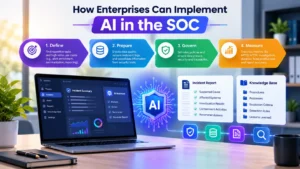 The AI adoption process can bring benefits to the enterprise, but it is crucial to consider the purpose, data, and protection during the implementation. First of all, enterprises should define the tasks that are repetitive and take much of the analysts’ time. For example, alert enrichment, incident summarization, and report generation are suitable options to choose from.
Second, companies should pay attention to data quality. Security teams should verify data accuracy, remove irrelevant logs, and consolidate information from different security tools.
Third, organizations should create a set of rules and regulations about the data and security aspects of AI. Organizations must establish governance policies for data use, privacy, and AI-driven decisions. They must also ensure that AI systems take only authorized actions and keep every action traceable and auditable.
The security teams should measure AI progress through the mean time to detect, mean time to respond, investigation duration, false positive rate, and the accuracy of the summaries and reports. Thus, enterprises can gradually introduce AI technology and accumulate experience to ensure that everything operates correctly and complies with the security goals.
Challenges of AI in Enterprise SOCs
Although AI offers significant advantages, enterprises must address several challenges.
False positives: AI may incorrectly classify legitimate activity as suspicious, requiring analyst verification.
Data privacy: Security logs can contain sensitive information, making access controls and secure data processing essential.
Integration difficulties: AI systems need reliable connections to existing security tools to provide useful context.
Adversarial attacks: Attackers may manipulate AI inputs or change their behavior to evade detection.
Overreliance on automation: Excessive trust in AI recommendations can result in poor decisions when evidence is incomplete or misleading.
Organizations can manage these risks through continuous testing, strong governance, analyst training, and carefully controlled automation.
Conclusion
AI in the SOC gives security teams in companies real ways to make threat detection better, make investigations faster, automate handling security incidents, make threat analysis stronger, and make reporting easier. These five important uses can cut down on tasks and let analysts pay attention to the security problems that really matter. AI works best when it has good data, clear rules, and people who know what they are doing watching over it.
Companies should start with tasks, check how well they work, and slowly add more AI. This way businesses can create security operations that’re better at what they do react faster and handle problems better while still making sure the people in charge are, in control of the most important security choices.

