
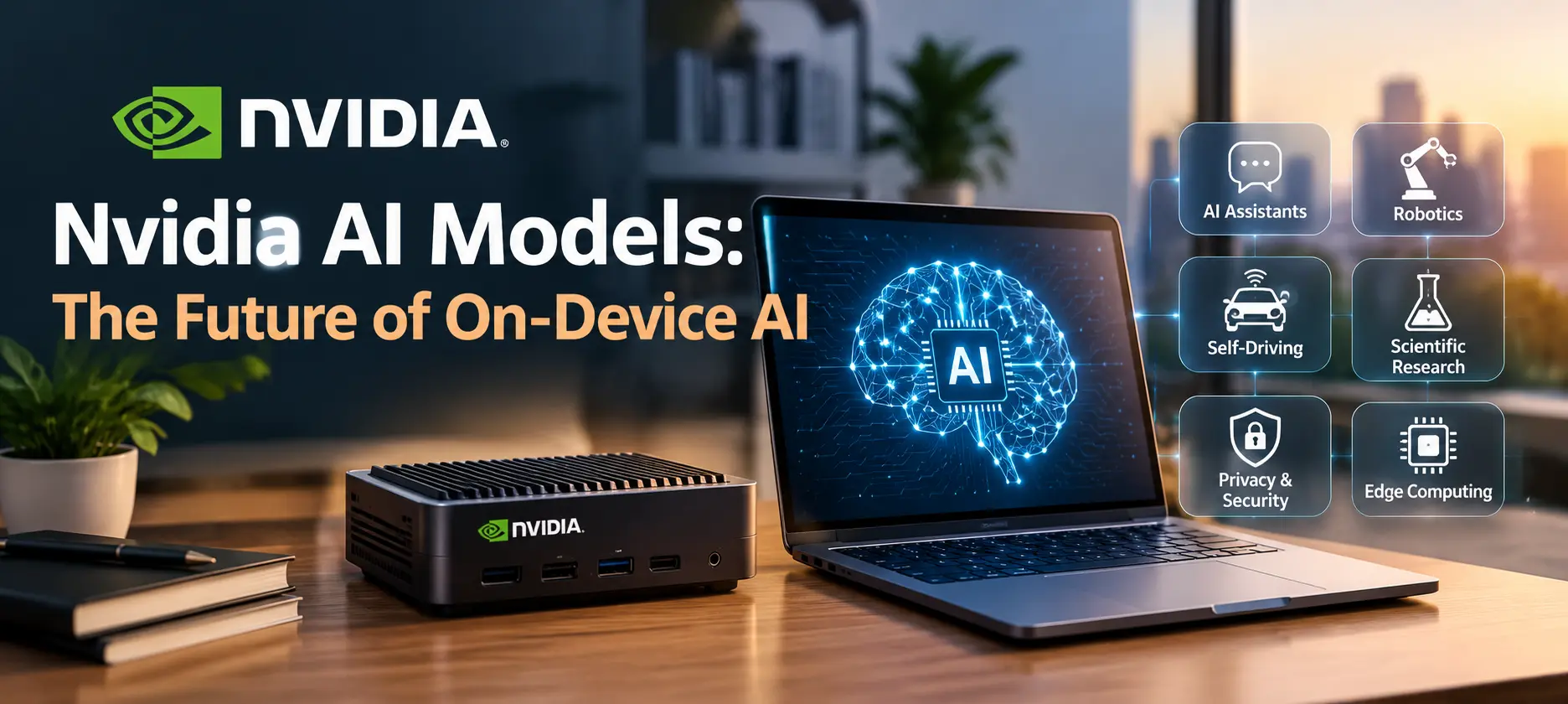
Nvidia AI Models: The Future of On-Device AI
Artificial intelligence is changing how we do our jobs, learn, and develop as a society. Yet, most AI applications are on large computers in data centres that respond to questions, generate content, and do other jobs. But we need to bring the same decision-making capacity to the point of use. NVIDIA is democratizing on-device AI through its AI models, hardware, and software tools that provide more pathways for developers to create and deploy AI apps on the edge. Though local AI has the potential to make numerous applications – digital consumer assistants, robots, and beyond – more powerful and flexible, it also presents some challenges, including silicon cost, privacy, and performance.
What Are Nvidia AI Models?
 Nvidia has a lineup of AI models for various applications – language, robots, science, and self-driving cars. The company offers various model families, each of which is designed for specific purposes, such as language and AI agent-related tasks (Nemotron), world foundation models for physical AI and simulation (Cosmos), robots (Isaac GR00T), and biological research (BioNeMo). The NVIDIA Alpamayo model family supports the development of reasoning-based AI systems for autonomous driving. NVIDIA’s AI models serve different audiences and use cases. Some products are designed for enterprises and scientific organizations, while others are developed for developers building physical AI systems. In this sense, NVIDIA AI highlights the company’s effort to go beyond silicon and enter the field of AI models.
Why Is NVIDIA Supporting Open AI Models?
Unlike many closed models, open AI models can offer developers more flexibility, depending on the model’s available components and license. Depending on the particular case and the model’s license, it can be possible to download the weights, analyze the inner workings of the AI, modify and fine-tune the network, and host it on private infrastructure. NVIDIA has open models, datasets, and tools for building AI solutions in the field. The company’s Nemotron, Cosmos series, and other models differ in their technical purposes and areas of application. Simultaneously, it is essential to recognize that the term “open” may be deceptive, and some models do not provide publicly accessible training data, code, and commercial rights. It is necessary to scrutinize the model’s particular license before employing it for commercial purposes.
What Is On-Device AI?
 On-device AI refers to the situation when an AI model is processed on a local machine or device instead of a cloud server. This local device can be a computer, industrial machine, robot, or any other compatible device. For instance, we can have an AI assistant on our own computer, which can search through documents. Robots could use on-device AI to process images their camera captures so that they can accomplish tasks or react to their environment. On-device AI could make robots not rely on the internet as much and could be faster depending on the device, the model, and the task itself. But that doesn’t mean that a device will stop using the cloud altogether. Some systems still need an internet connection when users require external data or more powerful hardware to process input data.
How NVIDIA Helps AI Run Locally
Running AI models locally requires more than just downloading the desired program; the device should have enough space and power to process the file. NVIDIA provides GPUs, libraries, and tools that allow AI model performance to be optimized. Users can run selected AI models locally with NVIDIA hardware and software, while systems like DGX Spark handle more demanding AI workloads. In addition, NVIDIA offers tools that enable developers to optimize AI models for specific devices and use computing resources efficiently. However, some NVIDIA AI models require significant memory and computing power, so users should research and choose models that suit their devices.
The Benefits of Running AI on Your Own Device
One of the advantages of local AI is that it provides more control over where the information is processed. Processing data locally can help an organization reduce the amount of sensitive business information shared with external services. Processing information locally may make programs faster, as there is no need to send each query to another server. Using a local AI decreases the amount of dependence on the internet, thus providing some applications with a chance to operate even when there is no connection. Additionally, programs that use local artificial intelligence can provide companies with more control over their expenses, as they do not have to host their algorithms elsewhere. They are not always an advantage, though, as hardware, power, maintenance, and software development can be costly. Companies need to work out if hosting these locally would be more expensive than using the cloud.
How Open Models Help Developers
 Open models can provide a foundation for developers. Developers can evaluate a model’s performance and adjust it to achieve the desired results. An example would be if someone tried an AI assistant for customer care or an app that lets its users access information from internal documents. NVIDIA offers its models and dev tools on sites like GitHub, Hugging Face, and its own developer service site. This can let researchers, start-ups, and established companies experiment and branch out in their work. But having a model up and running isn’t the whole solution, since people need to know what they’re doing in order to get accuracy, deal with licensing, protect data, and make sure the finished product actually works.
Real-World Uses of On-Device AI
It’s easy to imagine uses of on-device AI in the home or workplace. Cameras can identify objects with the help of on-device AI; local AI assistants installed on a computer can locate and summarize documents; production facilities can identify objects with the help of AI systems and inspect them; and robots can identify objects, including humans, with the help of on-device AI. On-device AI can improve speed and efficiency depending on the data, model, and task. Companies must evaluate on-device AI before deploying it to complete critical operations.
Can On-Device AI Improve Privacy?
Organizations are driven to go local by privacy concerns. In addition, locally implemented AI algorithms can help keep sensitive data on private servers. For example, the organization can utilize local AI to process confidential information on its devices instead of relying on external services. However, it should be noted that the application may utilize external online resources, have vulnerabilities, or have improper confidential data protection mechanisms. From this perspective, organizations need to ensure that the selected application for the local AI meets all the requirements, undergoes the appropriate security audit, and offers the necessary protection modules. A reliable privacy framework should have appropriate use of technology, relevant policies, and the necessary end-user awareness.
The Challenges of Local AI
 While on-device AI has its advantages, it is not without its downsides. Some more sophisticated models will need more memory and computing power than what is available in a standard device. In some cases, the additional hardware can be costly for small businesses. Local AI will need to be tested and maintained regularly. Smaller models run faster but can have difficulty when it comes to complex operations. Firms should protect open models and their access to prevent security risks, so they should test the models and evaluate their costs, security, and effectiveness.
Will Local AI Replace Cloud AI?
The use of local AI is unlikely to replace cloud AI altogether due to the advantages offered by both solutions. Users can run local models for simple tasks that need faster responses or avoid sending large amounts of data. More computationally intensive processes can be performed by cloud-based solutions. Thus, one solution may act as an auxiliary tool for another, depending on the needs of the moment. Users should choose the best option based on local storage capacity, available processing power, and the cost of cloud access. NVIDIA’s entire AI ecosystem allows organizations to develop products that use either local or cloud AI, depending on their needs.
What NVIDIA’s Strategy Means for Businesses
NVIDIA’s investment in open models and local AI will lead to the company’s products offering businesses a choice of solutions: language models, robotic ones, scientific ones, and more. Companies can select the model they require and also opt for an on-prem, cloud, or hybrid approach for AI. A small business adopting AI for the first time should start with a simple solution designed to address a specific need, like document search or finding the required information for employees. Organizations should run a pilot to evaluate the solution’s effectiveness and cost-efficiency in practice, then scale it up after they mitigate the risks. The company does not want to invest heavily in hardware if the use case is not viable.
What to Expect From On-Device AI in the Future
On-device AI is a space worth monitoring since developers continue to make discoveries and find more efficient ways to do their work. Moreover, improvements to the models themselves, combined with memory and supporting hardware optimizations, should make it possible to run truly useful, high-performance AI on various devices. NVIDIA’s investment in open models and local computing is likely to contribute to this trend, but it probably won’t apply to all platforms. Cloud platforms handle some tasks better, while local AI systems handle others more efficiently. Finally, the effectiveness of such technology is difficult to predict; therefore, businesses should track the upcoming advances and wait for particular use cases that would enable them to profit from AI locally.
Final Thoughts
NVIDIA’s AI models demonstrate that AI extends beyond cloud-based chatbots to applications such as robotics, scientific research, and on-device computing. Open models can offer more flexibility for developers, and on-device AI can make some applications more responsive and perform information processing closer to the source. However, businesses should consider local AI’s hardware demands, maintenance costs, security risks, and accuracy limitations. In addition, open models have licenses that developers and organizations should study before investing time and money in the technology. The best way is to examine needs and uses, test various models, and compare the results of using local and cloud AI. Although NVIDIA’s models and development tools offer useful capabilities, their practical value depends on how well they address real-world needs.

