
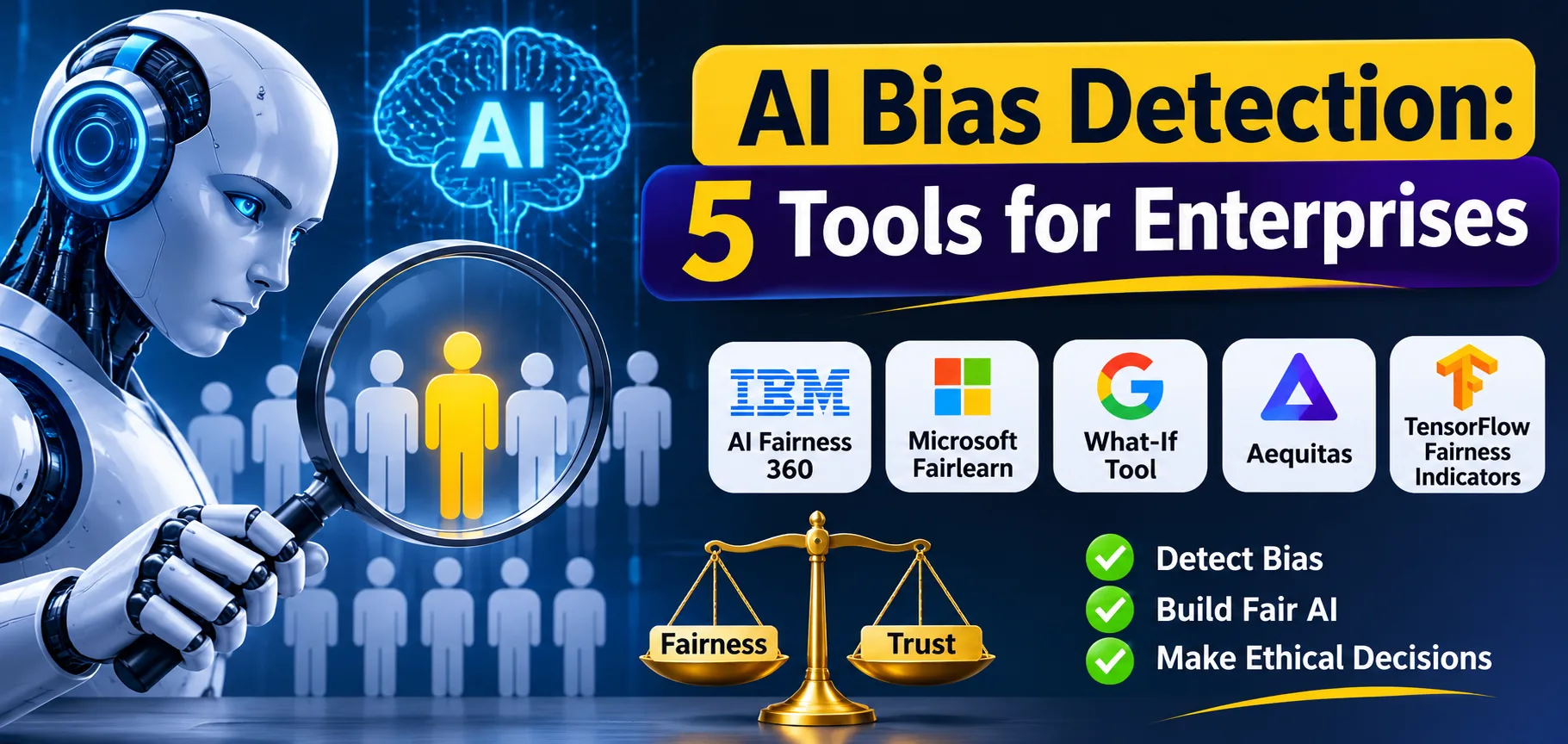
AI Bias Detection: 5 Tools for Enterprises
Artificial Intelligence (AI) is reshaping how companies operate. It’s in everything from automating the screening of resumes and analysis of user data to approving a loan, detecting fraud, and providing data-driven business decisions. In addition to letting staff automate repetitive work and make them more productive, AI opens up possibilities for bias – that is, biased training data, model design, or business use can cause a model to output biased results. For instance, in the recruiting world, you might get an AI model that is biased for one candidate if, for example, the training data was from a dataset where that candidate had significantly higher success rates than the rest. And that can harm business and existing jobs. AI bias detection helps organizations identify and reduce unfair patterns in AI systems. Here are five tools that they can use.
What Is AI Bias Detection?
 What is AI bias detection? AI bias detection is the act of searching for the presence of bias in an AI model. Bias can also creep in during the development of an AI system, as it relies on the information it’s given to work with. Bias in the model: When you train a model with biased data, the output will be biased too. For example, if a company was training its AI system to help shortlist potential job applicants – using the existing database of previous new hires – then the system might favor male applicants if the existing database was mainly male candidates.
Why Do Enterprises Need AI Bias Detection?
AI Bias detection allows you to discover and rectify biased results. Businesses are utilizing artificial intelligence to make vital decisions in banking and insurance, and in hiring and healthcare. But your machine learning model might turn away superb candidates, may discriminate against some customers, or may provide incorrect recommendations. Your reputation, the trust of your customers, and possibly your legal liability could all be on the line if the decisions your company makes are unlawful. As you evaluate your AI, you will be able to expect and identify these biases, and learn what equity for everyone in your AI might look like, so you can make more informed decisions, reduce the risk of negative outcomes, and realize the value of the technology at minimal risk.
5 AI Bias Detection Tools for Enterprises
IBM AI Fairness 360
IBM AI Fairness 360 is an open-source toolkit that helps companies identify and reduce bias in AI systems. It provides multiple algorithms to test for bias in a model, which an enterprise could apply to its training data or the output from its models. For instance, a bank could use the tool to see if the way it uses AI to approve loans is not unfair to certain customers. The library offers several techniques to help practitioners reduce certain biases and supports both R and Python. Organizations can use its results to help identify where they need to improve their models, but work needs to be done in the company to analyze the results and identify fair and effective algorithms to use.
Microsoft Fairlearn
Microsoft Fairlearn enables companies to evaluate how fair and accurate their AI models are for groups of people. This open-source toolkit lets AI developers analyze model performance by comparison between models and disparity in outcomes among groups. A business might evaluate a hiring model to see if it results in all qualified candidates being offered interviews regardless of gender or racial group. Fairlearn offers techniques that can lead to less unfair results in some cases, but at a cost to accuracy and other model quality measures. It is a Python-based tool that looks for bias during development and testing of machine learning models, but can’t ensure fair decision-making.
Google What-If Tool
Google What-If Tool gives developers an idea of what the models predict. Users can modify the input parameters, visualize the comparison between model outputs, and analyze model outputs across variations in the inputs. These features assist teams in debugging the model and probing it for bias: for instance, does the model predict differently for people with similar inputs? The tool is no longer actively maintained, so in new projects, businesses should consider whether it is compatible with the new software and consider more actively maintained alternatives for running the normal bias test.
Aequitas Bias and Fairness Audit Toolkit
 Test fairness with Aequitas. Aequitas is an open-source tool that helps teams identify biases in an AI system. It allows you to evaluate the performance of a model for various social and demographic groups. For example, a financial company can use Aequitas to examine whether its AI risk assessment system produces different outcomes for people from different demographic groups. These comparisons can help companies find topics on which to do additional research. The system allows companies to evaluate their AI models and locate problems related to fairness. This output can help teams produce a report on the analysis results. Aequitas will not correct the issues detected. It assumes the user has the training and understanding to interpret the outputs and implement the changes needed.
TensorFlow Fairness Indicators
TensorFlow Fairness Indicators allows developers to measure bias in AI by assessing how a machine learning model performs across various groups. It compares statistics and can identify instances where a model’s accuracy varies. The use case: A healthcare organization can utilize Fairness Indicators to assess if its predictive system built with AI delivers varying results across patient groups. This information can guide developers towards problem resolution. TensorFlow Fairness Indicators were designed for TensorFlow models. You can test other models with Model Agnostic TensorFlow Model Analysis. Your team can monitor the performance of your AI, but as a developer, you’ll need to select the right metrics and examine the output with subject matter experts.
AI Bias Evaluation Checklist for Enterprises
Check the Quality of Training Data
The first step in identifying AI bias is to review the training data. Businesses need to ensure that their AI models are trained on an adequate quantity of diverse data. If there is incomplete or skewed data, the AI system will tend to give skewed results. If a job placement system receives most of its training data from existing employees of one ethnicity, it will learn to prefer the applicants of the same ethnicity. It is essential for businesses to review the source of the data and the presence of gaps in the data. Balanced data cannot fully prevent biased results, so businesses need to continue their efforts to monitor the use of data and test the models.
Test Results Across Different Groups
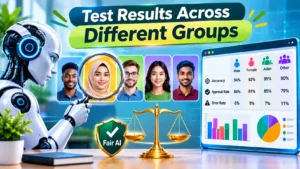 Test how the AI system performs across different groups of people. Some model performance metrics are lower for certain groups than for others. For facial recognition software, error rates can vary across demographic groups. The algorithm, image quality, and groups being tested can affect these differences. Compare the results of key measures (such as accuracy, approval rates, and error rates) – especially across user groups. They can help to expose biases that aren’t obvious in overall performance metrics. Select performance metrics that are appropriate to the intended use of the AI. To see how technology will affect various segments of the population, the company might compare user segments.
Review AI Systems Regularly
Why is routine testing necessary? AI systems are often updated or modified in business environments. This means that, over time, a tool’s outputs or recommendations can change, even though it is used in the same way, by the same business process. For example, a bank might expand the range of data used in determining the creditworthiness of applications, including when loans are approved. This new information can change outcomes for some people. Once in a while, companies need to go back and test their AI tools following major updates and watch for strange outputs. Technical teams should document tests and changes to identify and investigate problems. This can catch issues early.
Include Human Review
Businesses should not rely on AI solely for critical business processes. Human employees should double-check decisions that could have a major impact on customers’ lives. This might involve having a human reviewer at the point of final hiring approval to ensure the resume recommendations made by the algorithm are valid, or having bank employees double-check loan decisions or customer complaints recommended by AI. Human review can help companies identify when their algorithms are wrong. Workers need to know how to signal incorrect results and how to ask for additional examination. And they must empower their staff to manage AI responsibly and keep it under control. It will be a relief to businesses to have safer AI and less risky decision-making that may affect their clients and staff. And oversight is especially important in high-impact areas of business.
Create Clear AI Policies
For openness, organizations need guidelines on designing and implementing each of these AI systems. Companies need to determine who is evaluating the outcomes of the AI, the criteria they need to apply to those evaluations, and how to escalate concerns about issues. Managers should be aware of the system’s objective, training data, pros and cons before implementing it. Companies should educate employees to spot AI bias. Regulations must be dynamic in order to adapt to the constantly changing environment.
How to Choose the Right AI Bias Detection Tool
 The best AI bias detection tool will vary based on a company’s needs and the skill of its teams. Many tools are best for developers because they work well with code, and the tools offer visualization features that are easier to explore. IBM AI Fairness 360 and Microsoft Fairlearn help businesses evaluate machine learning models for fairness. Google’s What-If Tool lets users explore model predictions through visual tools. It is important to evaluate the features, technical specifications, and accessibility of any chosen tools and consider what you want to test the AI system against. An effective tool can help the team to identify potential problems and analyze the model’s performance to help inform your decision.
Challenges of AI Bias Detection
Identifying bias may not be obvious. Unfair outcomes can manifest in several ways. Models can still achieve high performance scores, but perhaps they do not perform equally well for various groups. Biases can also be present in substandard training data sets, model design, or changing customer data. Furthermore, multiple checks for fairness in place can also detect any variations in the model’s outputs. This can make it difficult for organizations to determine what is ultimately fair. There may be a shortage of skilled professionals who understand data analysis and AI testing. Conventional machine learning bias tests can’t expose all bias problems, even with modern generative AI models. Organizations will require a range of human monitoring and technical testing to address such issues.
Conclusion
Biased AI algorithms can harm customers, employees, and businesses. Five tools that organizations use to test their AI systems for bias are IBM AI Fairness 360, Microsoft Fairlearn, Google What-If Tool, Aequitas, and TensorFlow Fairness Indicators. But those methods won’t identify all types of bias or test all possible versions of a model. Companies can audit the training data, track the results of their AI on different groups of people, monitor the model’s performance, and keep human judgment in the process. Clear policies and practices will help enable a regular testing workflow. Implementation of appropriate bias detection tools and regular testing will allow companies to minimise bias and improve decision-making.

