
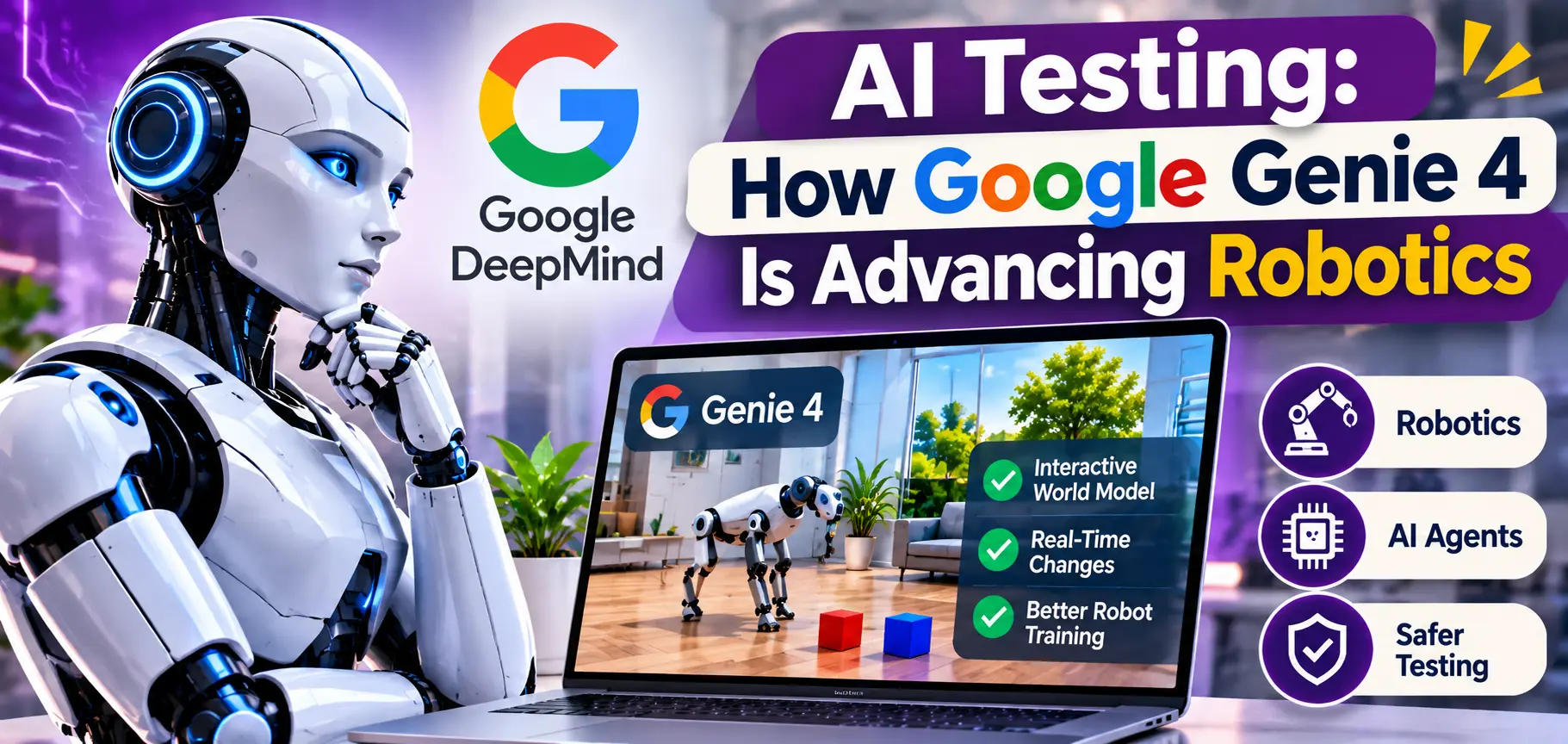
AI Testing: How Google Genie 4 Is Advancing Robotics
AI is advancing rapidly and can now understand and simulate our world. For instance, Google DeepMind launched the Genie 4 world model, capable of being interacted with in real time, on 27 October 2026. Users can also change the environment by giving natural language instructions. The technology has piqued interest because it could help researchers to generate testing and training environments for AI agents and robots. Rather than trying out ideas in a physical environment, they can try them out in a simulated environment first. However, this is still a research preview and not fully developed for robotics.
What Is Google Genie 4?
 This is an image from the world model known as Genie 4, which is from Google DeepMind. World models are AI systems that study how to interpret the environment by learning patterns. They can then use that knowledge to generate scenes and interpret the actions of users. Unlike most video generators, Genie 4 allows users to interact with and change the environment after creating it. This means that users can request changes such as different weather, camera movement, or new objects. The system will try to make changes to the environment but maintain a coherent experience. Due to the interactive nature of the system, this could be useful for research and testing purposes.
How Google Genie 4 Works
Genie 4 incorporates features from Google’s Gemini models. For instance, the Gemini Omni model can simulate realistically, using a visual created as if it would appear and behave in the real world. Other Gemini models are used for reasoning to keep the simulation flowing. Genie 4 creates visuals, responds to what occurs, but can also create audio to help complete the simulation. It can generate background noise and sound-based interactions which help make the simulation more realistic. When interacting with the simulation, there will be sounds such as wind, water, and characters speaking. While this could provide useful context for certain experiments, having realistic sounds doesn’t mean the simulation is accurately portraying the real world. The developers will have to thoroughly test how it works.
Real-Time Changes Through AI
 The simulation can be controlled using natural language. Users can ask Genie 4 to change different parts of the environment. For example, a robot developer may wish to look at a room with the lights off or look at how their outdoor route changes in the rain. Genie 4 can create these changes while users continue exploring the environment. The players also have the ability to control the camera and add new characters or objects. This is helpful because different scenarios can be quickly created. This can help teams explore unusual scenarios which would be difficult, costly, or dangerous to create in real life. However, every scenario will need to be checked to ensure results are reliable. Every result will need to be very carefully reviewed by the researchers.
How AI Testing Can Help Robotics
One of the most exciting applications of world models is in robotics. Robots are constantly faced with new environments, whether it’s the toys scattered across the floor of an office or the people, lights, and textured surfaces of a more complex environment. The robot may excel in one clean space but fail to navigate a chaotic factory floor. Programmers can run simulations to put the robot in different scenarios – finding objects, dodging obstacles, and interacting with people. Over time, Genie 4 could assist the team in designing environments that test those interactions. The team agrees, however, that simulation alone cannot ensure robots’ safety.
Testing Robots With Gemini Models
Google has also shared research demonstrating how Gemini 4 Argon works with Genie 4 to simulate complex tasks. Here, the Gemini model can decompose a task, monitor the simulation, and adapt to changes in the scene. Genie 4 creates the environment that these tasks occur within. This has been demonstrated in the past with a simulation of Apptronik’s Apollo humanoid robot playing checkers in the simulation. This shows what researchers can explore using the generated world, but this shouldn’t be mistaken for a demonstration of the Apollo robot learning and performing tasks reliably in the real world. Researchers use this only as an example of research, not as a complete robot training system.
AI Testing for Intelligent Agents
AI testing can also have other applications apart from robotics. Users generate AI agents designed to go through websites and software, interpret instructions, and complete some tasks. AI agents should be able to react to different scenarios. Researchers can create an artificial environment with different scenarios to observe how the agent adapts. Perhaps the test could include a blockage, a change in instruction, or an unexpected character. This would allow the researchers to see if the agent can detect the change and respond appropriately. Google designed Genie 4 for interactive environments, which could help researchers. However, how useful it is will depend on how accurate the created environment is to the task. Researchers can repeat the tasks and record the responses
Benefits of Safer AI Testing
 Initial testing could be safer. There is a risk of using robots in factories, on roads, or in buildings. Scenarios can be hard to simulate realistically without risk to people or objects, for example, flooding and dangerous obstacles. However, by using digital simulation, teams can experiment with these scenarios in a safe environment. Genie 4 can help researchers create a variety of scenarios that can be altered during testing. This will help to aid initial planning and help teams determine areas they would like to look into further. However, it cannot replace actual safety testing. Developers must still test robots on appropriate equipment, under supervision, and with appropriate safety measures. All teams also should make sure that results have been validated by performing physical tests accordingly.
Improving AI Performance Through Simulation
This also enables developers to compare the results of different techniques. Developers can see an AI agent run through each version of a scene. Researchers can change elements like lighting, weather, the placement of objects, and so on. We can do this to check for problems with an AI. Teams might also be wondering what tests will work best in the real lab. Researchers will need to ensure scenes are comparable and quantifiable so comparisons can be meaningful. If scenes aren’t consistent, developers will find it hard to know if their system has gotten better. Developers will need a reliable way of tracking the conditions and results. Consistent conditions can help the research team make more useful comparisons.
Limitations of Google Genie 4
There are some key limitations to Genie 4, despite its potential. Genie 4 is a work in progress, and visuals and objects may evolve over long play sessions or after many re-simulations. Developers also struggle with physical complexity, spatial and audio accuracy, text, and consistency. It is a challenge for roboticists to replicate the very sensitivities of robots to differences in distances, time, and object interactions. If the simulation is not a good enough match to what a robot experiences, then the robot may seem to sidestep an object and then smack into it. Researchers should use Genie 4 to explore and pilot ideas. You will still need to take real-life measurements.
The Reality Gap in Robotics
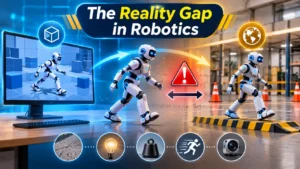 The other problem is simulation-to-reality transfer. This can lead to problems as the simulated environment differs from real life, such as different friction between the floor, lighting differences, mass, motion, and sensor values, which will result in the robot behaving differently between training and testing environments. To address this issue, researchers will aim to improve their model based on physical experimentation and comparisons of simulation results. While Genie 4 can help create more diverse environments, there is still no guarantee of accurate results. Developers will need to ensure that key details are accurate to the real task to make use of simulation results to inform their deployment decisions. More evidence is still needed.
Availability and the Future of AI Testing
Right now, Genie 4 is offered as a research preview to a small set of trusted testers. While Google intends to provide access to those using their Project Genie (Google AI Ultra subscribers) and early adopters via Gemini API and Google AI Studio, access will evolve during the research preview. Please check the official Google DeepMind statements for the latest. As Genie 4 is not a complete enterprise robotics package yet, we recommend you follow the research, digest the demos, and see if this could work for your experiment. If you are a company exploring this, make sure you have a clear understanding of the data, safety, and validation. Check for any changes with official updates.
Conclusion
The Google Genie 4 demonstrates how AI research is moving towards interactive world models. This has the potential to provide researchers with new ways to experiment with tasks using the dynamic environment, natural language understanding, and audio generation capabilities. Developers can use this technology to explore many scenarios in robotics and AI agent development. However, this technology is still in a very experimental phase. Researchers must take time to ensure that generated scenes are realistic. A method that works in simulation may not work in the real world. At this stage, researchers should treat Genie 4 as a research tool. The effectiveness of the project will rely on the extent to which improvements are achieved to allow it to become more precise, consistent, and easy to use.

