
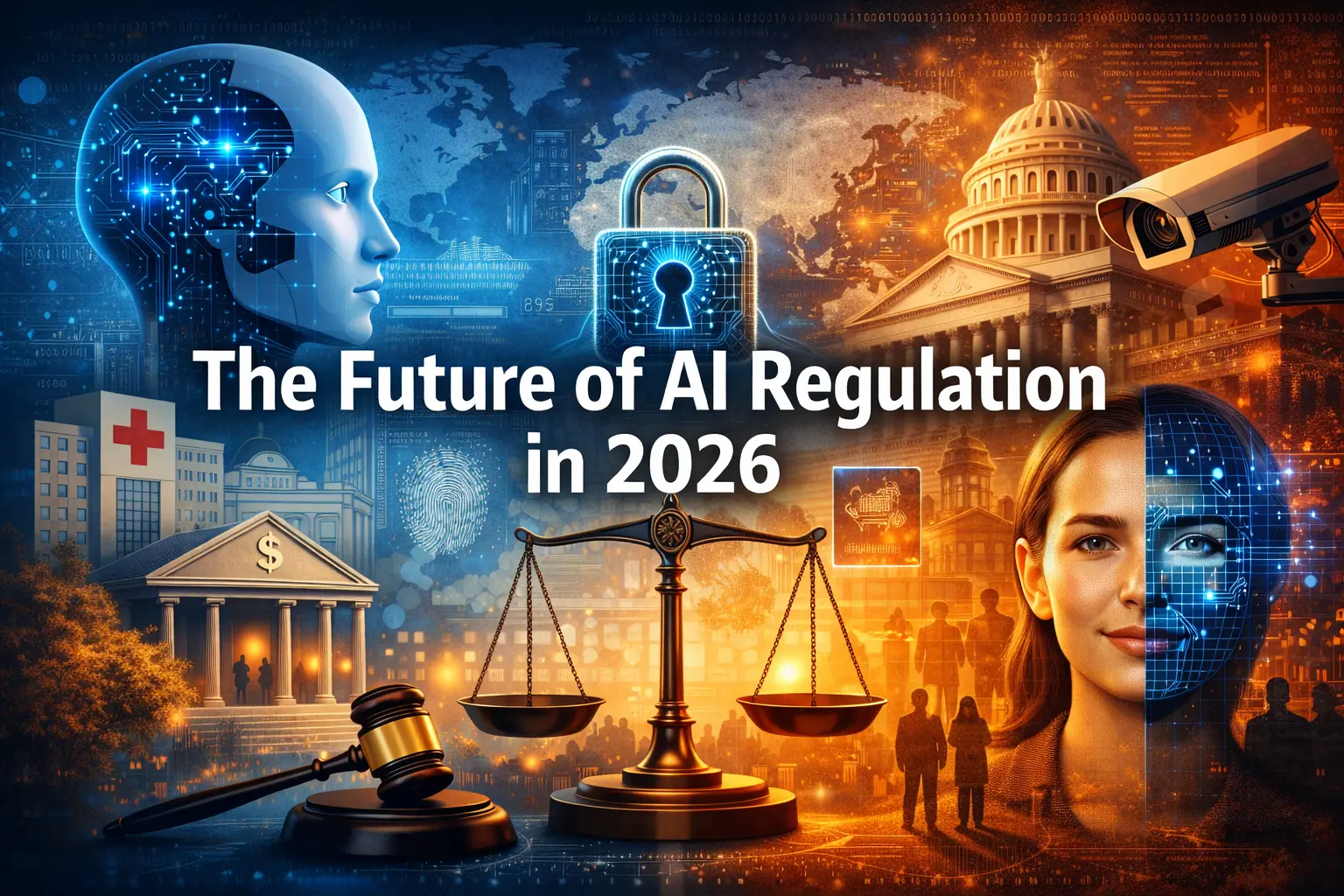
The Future of AI Regulation in 2026
Artificial Intelligence has become part of every aspect of our lives, and people now use it day in and day out without giving it much thought. AI is involved in many aspects of daily life. However, new fears are also growing as AI gathers pace. Concerns about privacy, biased decisions, and misuse of personal data are increasing. As a consequence of these problems, it is the government’s turn to seriously consider the regulation of AI. AI legislation is tightening more than ever in 2026 onwards. Governments are enacting tangible laws that companies must comply with, moving beyond vague guidance. These regulations protect users and ensure responsible technology use. The prospect of AI regulation is not just important to the B2B tech firms; it is important for every person who uses digital services on their phone each day.
Why Strong AI Laws Are Needed
 The growing importance of AI regulation in 2026 is due in part to the intense pace of AI development in sensitive and high-impact domains. Now, AI tools can be found everywhere — in healthcare, banking, hiring, education, and public safety. Without proper monitoring, these systems can turn harmful — a single biased or erroneous decision can cause physical harm to individuals and erode public trust. For instance, a defective hiring algorithm might screen out qualified candidates, while a medical AI system may suggest unsafe treatments. In order to stop such damage, governments around the world are enacting tougher legislation, which necessitates comprehensive testing and clarity prior to the deployment of AI tools.
Europe Leading the Way in AI Rules
Europe is leading the way through the implementation of the EU AI Act. This major legislation is slated to take full effect in 2026 and offer transparency on how companies must develop and use AI. The Act categorizes AI systems according to their potential risk. Simple chatbots are subject to minimal requirements, while high-risk systems for use in healthcare, banking, and law enforcement, among others, are subject to stringent regulations. They include rigorous safety protocols, transparency requirements, and ongoing surveillance. Companies need to be transparent about how their AI tools make decisions and ensure they are not harmful to users. Given that many multinational technology companies do business in Europe, they’re now bringing their products in line with these standards. As a result, European AI regulation is setting the standards for global technology practice.
How the United States Is Regulating AI
The United States is taking a piecemeal approach to AI regulation compared to Europe. Rather than passing a single nationwide legislation, several states are crafting their own policies and legal frameworks. States such as California and New York focus intensely on data privacy, algorithmic transparency, consumer protection, and equitable AI use. Meanwhile, overarching guidance and advice from the federal government, especially for AI systems in government agencies, public services, and national security, is gradually emerging. This gives firms more room to develop emerging technologies. This approach also creates difficulties because rules differ from state to state, and this makes compliance more difficult for companies operating nationwide. But the general direction is clear. By 2026, American organizations will be under increasing pressure from regulators and the public to engage in ethical treatment of, and responsible, accountable, and transparent use of AI.
Asia and the UK: Taking Action
 Governments in Asia and the United Kingdom are also pursuing serious and proactive regulation of the burgeoning influence of artificial intelligence. Nations such as South Korea, Japan, and Singapore are developing new legal regimes that focus on ethical AI development, human oversight, and safeguarding user rights. They want to make sure that humans remain in control of the technology and that it is used in ways that benefit society, not harm it. China isemphasizing the regulation of AI-generated content, especially deepfakes, fake videos, and manipulated images that misinform the public. At the same time, the U.K. is drafting tailored regulations to ensure safe use of AI in critical industries such as healthcare, education, and public service. While each region takes its own legal style and emphasis from the approach, there is a similar intention. By 2026, responsible AI governance is gaining global rather than regional traction.
Making AI Transparent and Fair
Transparency and responsibility serve as the compass of AI regulation in 2026. With artificial intelligence (AI) increasingly involved in making high-stakes decisions, many people don’t know how these systems arrive at their outcomes. This lack of transparency particularly worries people when AI operates in sensitive areas like hiring, lending, education, or healthcare. To combat this, new rules will force companies to be more transparent about how their AI tools work and what kind of data they are based on. These regulations make AI systems more open, understandable, and trustworthy to the general public. Accountability is another major concern. When an AI system makes a harmful or unfair decision, it should be clear who is responsible for that outcome. Governments are working to determine whether responsibility should lie with developers, businesses, or end users. Clear accountability measures are critical to sustaining long-term public trust in AI technologies.
Safety Testing Before AI Is Used
In 2026, safety testing is becoming a significant part of AI regulation. As car and drug companies are required to safety-test products before selling them to the public, so too must developers test AI systems before rolling them out. AI products should be subject to review by independent experts and government bodies to ensure they are safe, fair, and reliable. When AI is used in critical places like hospitals, banks, schools, and government agencies, it only makes matters worse — mistakes can mean loss of life. If the system fails, the company has to correct it and improve itbefore deployment. Those safety checks prevent user harm and motivate companies to build better, more reliable products. Consistent evaluation will result in better AI and more trust in its uses over time.
Stopping Deepfakes and Fake Content
 Another significant worry in 2026 is the exponential growth of deepfakes and AI-generated digital content. Sophisticated AI tools can produce fully realistic videos, voices, images, and sounds. Although this is a movie-friendly tool, which is great for games, movies, and other creative works, it can be very damaging. Threat actors might weaponize deepfakes to misinform, commit fraud, influence elections, and damage reputations. To tackle these issues, a few governments across the world are enacting laws and regulations concerning synthetic media. Governments are bringing in tough punishments for the abuse of such materials. Governments enforce strict regulations to curb abuse, maintain online trust, and limit fraud, identity theft, and election interference.
Challenges in Controlling AI
Nonetheless, even with regulations now in place, governing AI is still an evolving and challenging task. A key challenge is to strike the right balance between security and innovation. Too strict requirements could hinder companies from pioneering in the development of AI, thus stifling progress and beneficial innovation. However, if the regulations are too lax or ambiguous, the systems may be used to harm people, produce unfair outcomes, violate privacy, or pose security problems. Another key challenge is that AI runs across borders, but laws and regulations differ from region to region. Global firms must comply with multiple regulations at once. This can be expensive and confusing. To meet such challenges, international bodies are seeking to establish common norms for the use of AI. By 2026, collaboration of governments, enterprises, and experts will be more needed.
Conclusion:
The trajectory of AI regulation in 2026 makes it clear that the era of hands-off AI development is over. Governments worldwide are intervening in unprecedented ways to shape the development of AI so that it is safe, fair, and ethical. The governments are developing strict and clear rules that will protect people, require transparency, and make companies accountable for the technology they develop. They build public confidence in AI and incentivize the private sector to innovate and advance best practices. Although challenges such as the speed of technology development, differences in national legislation, and the difficulty of regulating global AI systems persist, momentum is gathering. The appropriate approach is to balance encouragement with safety and establish a reasonable risk level for AI to prosper without putting society in harm’s way.

