
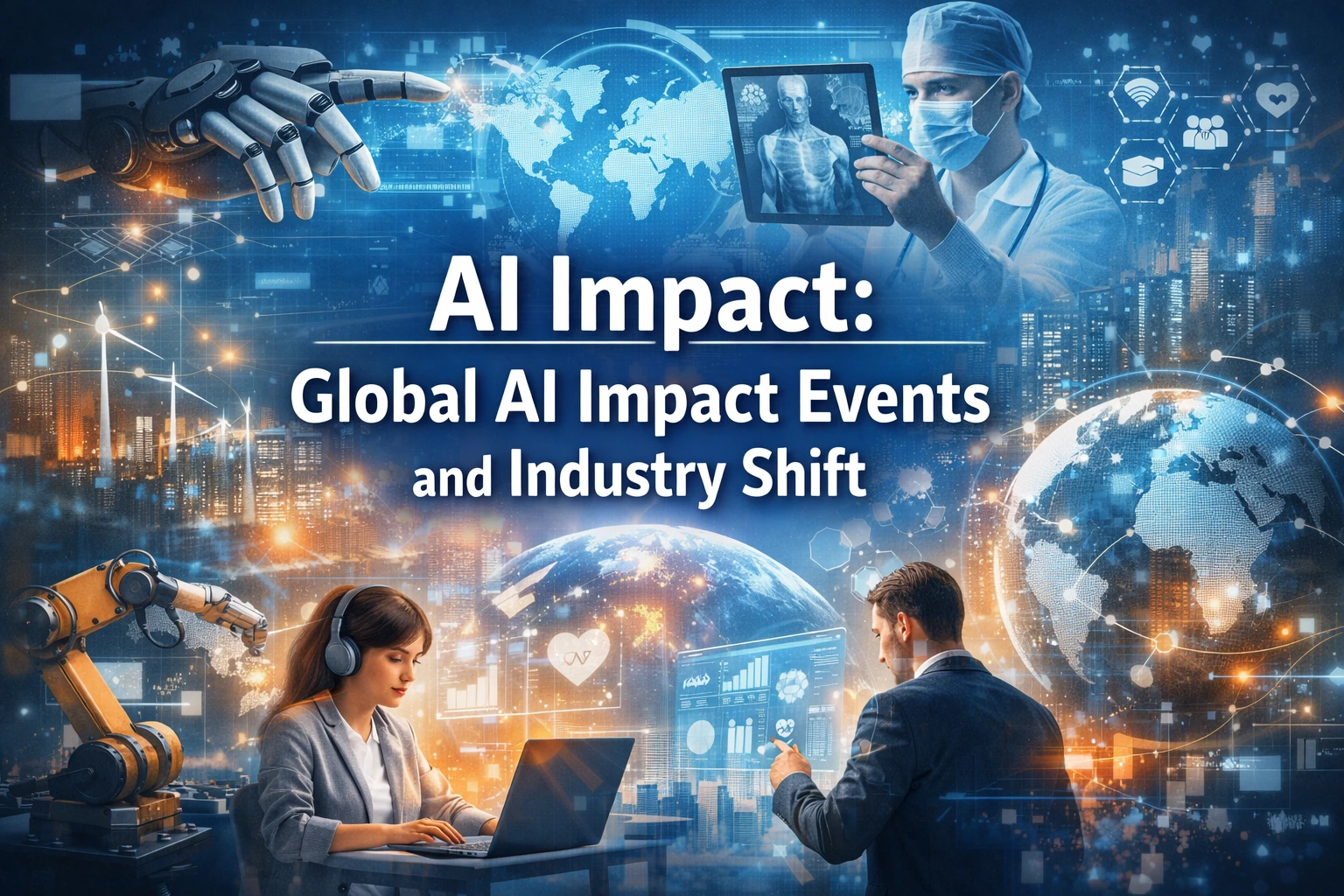
AI Impact: Global AI Impact Events and Industry Shift
AI impact is changing industries, healthcare, and the way we live and educate ourselves faster than any other technology before it. In 2026, AI will finally be working its way out of the research labs and into homes and businesses alike. Hospitals, schools, government agencies and multinational corporations are already implementing AI to become more agile and smarter. AI’s effects show how artificial intelligence impacts individuals, organisations, and governments. It is making life easier in hospitals and helping people learn better. AI is everywhere in our lives. Authorities, education institutions, and businesses have all undertaken automation to empower other organisations. This is a worldwide movement supported by spectacular Artificial Intelligence exhibits and sector new releases.
Why Global AI Events Matter
 AI impact is essential because it helps us prepare for the future. The actions we take will decide the future of work, learning and society for the years to come. The manner in which AI is utilised is going to shape the pace of economic growth, levels of employment, social welfare, etc. The way we use AI shapes economic growth, jobs, social welfare and human well-being will depend on how we apply it. In 2026, many global AI conferences and technology symposiums will be held. Leaders are discussing how AI can contribute to solving social problems, including climate change, the medical system, and education. They debate the risks, from job loss to the potential misuse of AI. These world events are significant, as they dictate the future of AI. In their absence, nations might have been left to adopt AI in ways that were harmful or unfair.
AI Impact on Global Industries
AI is now developing around manufacturing, finance and retail all across the world. Businesses are now applying AI to make the way they work better, faster and cheaper. In manufacturing, AI-powered robots are producing goods more quickly and safely. The banking sector uses AI to recognise fraud and manage investments. In retail, AI recommends products to shoppers and tracks inventory. Even agriculture is taking advantage of AI to forecast weather and enhance plant growth. This trend is driving businesses to be more agile and productive. Industries that adopt AI tend to grow faster than those that don’t. As a result, many companies are betting big on AI. The shift in industry brought about by AI is one of the most profound transformations in the global economy.
AI and the Future of Jobs
 A lot of individuals fear that some jobs could be taken over by AI. Although some jobs will indeed vanish, many more will be created. AI will take care of the dull and monotonous work, freeing people to concentrate on more creative and meaningful work. Emerging jobs such as AI trainers, data analysts, and AI safety experts are picking up pace. Those workers who do reskill will be in the best position. Companies will require people who can think about technology and its impact on people. Governments and schools are also revising curricula in a bid to ready youngsters for workforce jobs dominated by AI. The future of work won’t be work without humans, but rather work with intelligent machines. Growing quickly are positions such as those involving AI training, chatbot developers, and data engineers.
AI in Education and Learning
Among the largest domains to be impacted by AI is education. Students are using AI tools in 2026 for studying, homework, and learning more in less time. AI tutors can help students understand difficult subjects. Teachers are utilising AI to grade homework and plan lessons. It reduces the burden and improves the standard of teaching. It can meet students’ individual pace and give individual attention; meanwhile, brighter students can develop more quickly. Schools and universities are increasingly digital and personalised thanks to AI. This shift allows education to be delivered to people all over the world, even those living in places where there are no roads.
AI in Healthcare
AI is enabling healthcare providers to deliver better care to patients. In-hospital AI can review medical records, scans, and test results within seconds. That enables doctors to detect disease early and select the best treatment. Healthcare providers use AI to predict health risks and improve hospital management. Patients can track their health and consult virtual doctors through AI apps. This is why health care is faster and more precise. In some countries, it is improving lives and reducing the risk of human error. And as technology advances, AI will continue to bring down the cost of healthcare and make it more effective for everyone. AI analyses X-ray scans, and AI can assist doctors in detecting cancer at early stages in some cases.
AI and Business Growth
Businesses now use technology to predict customer demands and improve the route optimisation process. Whether it is to understand the customer in a much better manner, accurately forecast demand or to optimise the scope for marketing spends, the “AI age” brings efficiency to all of this. And even small businesses are now looking to AI-enabled solutions to help them craft adverts, create logos and operate social media. It is what enables smaller businesses to compete with large corporations. AI also enables companies to reduce errors and to make more informed decisions, so they are able to derive more value from their data. Thanks to AI, they can process vast amounts of data and find meaningful patterns. That means better products and better services. As more companies get into the AI business, competition stiffens, and innovation blossoms. It’s why AI is playing an increasingly important role in the global business world.
AI Safety and Ethics
 This statement is more relevant than ever, with great power comes great responsibility. It is our duty to have a safe and fair use of AI. The melting pot of international AI summits is a step toward establishing regulations for preventing risks of using AI. These rules aim to deal with issues like data theft, spamming and biased decisions of the chatbot. Together, the private companies will work with the government to provide the conditions for AI to be in accordance with human rights. Ethical AI means that autonomous machines can‘t conquer human beings or discriminate among human races. Precautions for safety measures escalate as AI becomes more sophisticated. The target is to retain the utility of robotics for society, thus minimising the likelihood of receiving side effects. Such a secure AI system generates trust among users and supports sustainable development.
AI and Daily Life
AI will be a normal part of most people‘s lives in 2026. People already use AI in smartphones and smart homes, smart homes and Internet usage. You use voice assistants when you need speed and simplicity, for example, to set a timer or receive information. They will also suggest what you might want to buy, like music, films, and other items, on the basis of your tastes. Devices at home will control lighting, security and power consumption, and it will also make travel arrangements and even help you track your exercise routine. These devices will not only save us time, but they will also save us effort; people will hardly realise that they are using AI at all, and AI will develop to even become simpler for all of us to use.
Conclusion: The Future of AI Impact
The Future Impact of AI proves that artificial intelligence is the maker of the contemporary world. AI is influencing how people live and work across business, education, healthcare and communication. Sectors are embracing digital tools to make them faster, smarter and more efficient. Those who are able to learn to use it will have better opportunities in the future. But AI has to be wielded responsibly. We must handle the challenges to privacy and ethics, as well as changes to the workforce, with great care. Because of this, with sufficient intervention, it can support rather than replace human effort. The future of AI has many possibilities. Through wise conduct now, it is in our power to fashion a future in which technology and humanity advance in tandem for the good of all.

