
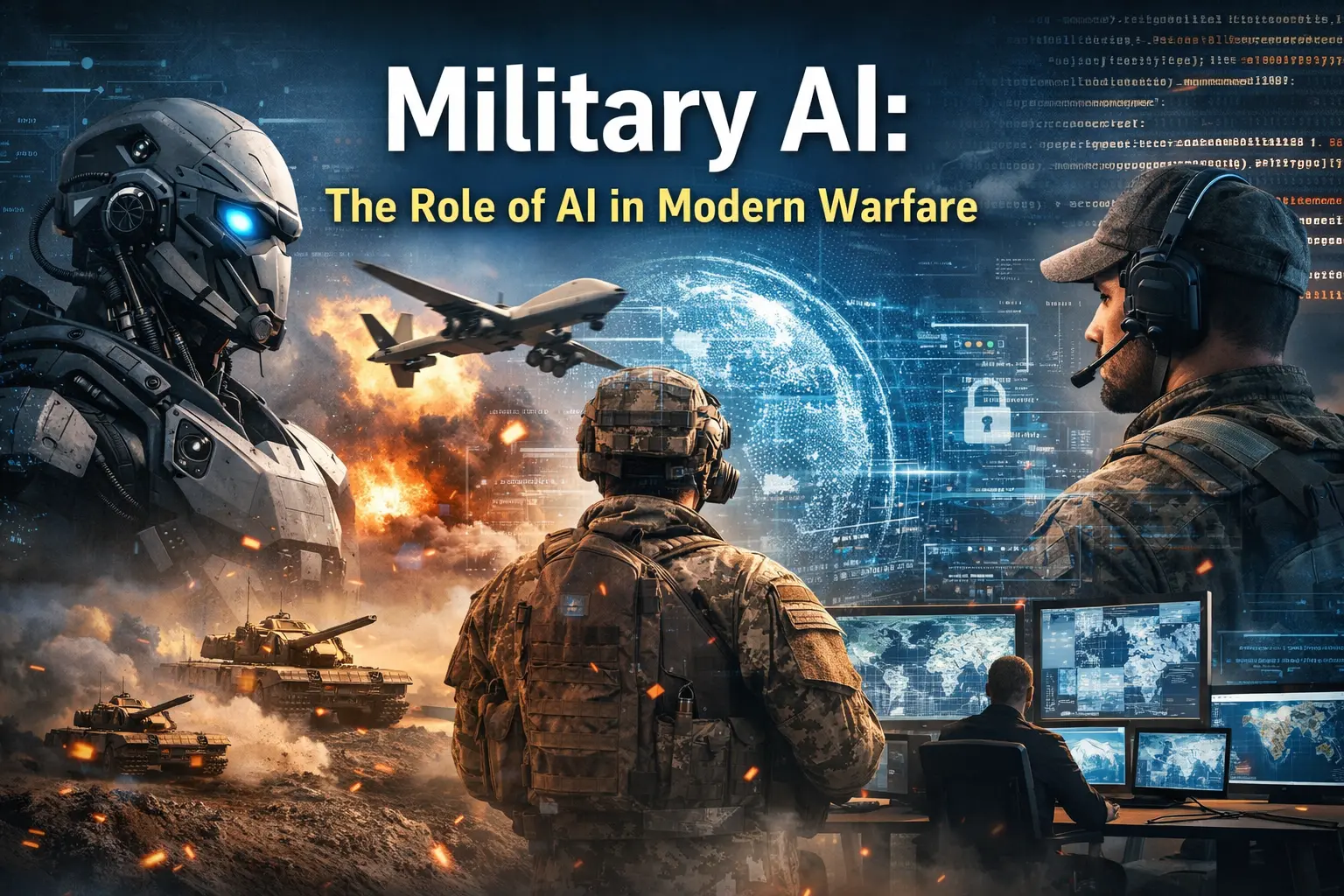
Military AI: The Role of AI in Modern Warfare
Artificial Intelligence is one of the crucial technologies in present day scenario. The technology has given rise to a new dimension in the application domains such as health, education, business, and transportation, etc. The defense is also one of the areas in which Artificial Intelligence is impacting largely. The defense technologies of all the countries are investing money in order to develop their defense systems more and more efficiently. Military AI is one of the concepts that involves artificial intelligence in military systems, intelligence, and defense technologies. War in the present scenario is unlike in the past, as today‘s warfare is highly dependent on technology. AI can process a vast amount of information in a shorter duration of time. Furthermore, an AI system may be employed in hostile zones where human soldiers would risk their lives. All these benefits have led numerous countries to develop and establish advanced AI systems to enhance military strength and national security.
AI in Surveillance and Intelligence
 AI‘s significance in modern warfare is also significant in terms of reconnaissance and intelligence gathering. Previously, officers needed to meticulously examine satellite imagery or documents, which was a tiring and lengthy process. AI Programs can sift through images, video feeds, or other sources in a matter of seconds. Indeed, in some areas of reconnaissance where the recognition of threats is concerned, artificial intelligence programs are better than human analysts and leave the military officers with enough time to react. Such AI programs can tirelessly watch large areas of land like the country‘s borders or the seas surrounding the nation and bases, and do not get bored. They offer an opportunity to gather different types of intelligence and link them together, presenting the military officers with a coherent understanding of what is going on so that appropriate plans can be made against the enemy‘s actions.
AI in Military Drones and Autonomous Weapons
One of the most common applications of AI used in the AI military is drones. A drone is a pilotless aircraft. Many drones are currently using artificial intelligence to assist in their flight and to target and perform their tasks. These drones can be used for reconnaissance, survey missions, and some attack missions. Since they do not involve a pilot being on board, they can safely be deployed in hostile environments. Autonomous weapons are another example of AI in the military. These systems can detect and engage enemies without human supervision to a certain degree. Some advanced systems can identify enemy weapons or vehicles and respond quickly during combat. While this can be highly advantageous in the military, many find that there are issues of concern regarding human supervision over lethal weapons.
AI in Military Strategy and Decision Making
AI is also assisting military leaders in making better strategies and decisions. Commanders make critical decisions in military operations rapidly. AI systems can analyze information such as weather conditions, terrain, troop movements, and enemy positions. A vast amount of information needs to be processed in order to guide the command decision, and at a fast speed, an AI system can present feasible suggestions. AI can run a simulation for different battle scenarios and provide expected results, so the commanders will be able to choose the best strategy and make decisions. AI can also contribute to logistics, including transportation, supply management, and equipment maintenance. It can predict and notify of the malfunction of a machine in advance to fix the machine before its breakdown.
AI in Cyber Warfare
The final type of warfare today is cyber warfare. AI Cyber warfare involves attacks on and defense of computer networks, communication systems, and essential digital infrastructure. The defense of military networks from cyber attacks is one of the main areas of concern that AI will address. AI security systems can monitor computer networks and detect unusual activity. AI can also search huge amounts of data and identify weak points in computer systems. In addition, countries may also be creating AI to enable them to carry out offensive cyber attacks, for example, systems that shut down enemy communications and utilities. But as long as the war on the web continues, the use of AI in national security is certain.
AI in Battlefield Communication
 A vital factor in Military operations is Communication. The soldier and the commander must be tied in for the accurate and swift dissemination of information. Contemporary AI technology is impacting communication in many ways. Information from communication streams can be processed, ensuring the correct recipient receives information instantly and reducing any chances of misinterpretation when the stress of the battlefield is taken into account. High-tech, AI-based communication systems are capable of running networks of enormous size and coordinating the actions of various army divisions, as well as defending them against any attempted hacks or interference from opposing forces. In the near future, AI communications could even transmit instantaneous commands and updates to soldiers through their military equipment, greatly increasing the military’s efficiency and responsiveness when engaged in combat.
AI in Military Logistics and Supply Chains
Bulk items such as food, fuel, materials, medical stores, etc. The logistics team must deliver supplies to the units deployed for the operation. For that, the materials must be transported and dealt with in a proper way. AI is transforming the supply and logistics chains in the military sector. AI systems can track supplies, monitor equipment, and predict future needs. For example, AI systems can learn from past data and calculate the amount of fuel, bullets, or medical items necessary for a given mission. It can also alert and prevent supply and logistics shortfalls. The AI systems are also monitoring the condition of vehicles, planes, or ships and predicting future maintenance requirements and issues. An early warning system helps in preventing any breakdown. AI-facilitated, efficient logistics systems can run operations smoothly even in the toughest scenarios.
AI in Military Training and Simulation
AI also helps improve the training of soldiers. Modern military training systems incorporate highly sophisticated and advanced technologies. AI will provide training systems to allow soldiers to train in a safe but realistic simulated environment. An AI simulator will simulate a combat situation where soldiers can practice strategies without risk of injury. These systems can modify the difficulty level depending on the soldiers’ skill. Both virtual reality and AI will simulate realistically any environment, from a combat training exercise to a rescue operation or an emergency situation. An AI will study soldiers’ progress to note any areas that may need improvement in training. AI can enhance the quality of training by providing the best possible preparation for actual combat.
Benefits of AI in Modern Warfare
 There are many other significant advantages to using artificial intelligence in a military environment. Speed is a considerable benefit of using AI. Systems of AI can review large volumes of information far more quickly than humans. This can provide a leader with decision-making power during urgent circumstances. Accuracy is another benefit of using AI. Systems can analyze patterns that humans may overlook and detect threats that human beings would miss. Robots and machinery performing hazardous duties also reduce the risk for soldiers. Robots can sense bombs, enter contaminated areas, or carry large loads of equipment. Maintenance, logistics, and planning are all enhanced with the use of AI. Because machines do not experience fatigue, they can operate for extended periods without losing focus.
Challenges and Risks of Military AI
Though there are many benefits to using AI in war, there are also serious problems. One serious problem concerns ethics. Who decides whether or not to attack a target? When machines make decisions to attack enemies on their own, accidents can occur, potentially causing serious injuries to people. A technical problem is the risk of malfunction. An AI may incorrectly target friendly troops or innocent civilians. Another problem concerns the risk of terrorist groups or other criminal organizations getting AI technology, and a race between states to develop more sophisticated AI weapons, also known as an arms race. Many specialists believe that AI used in weapons requires guidelines and regulations.
AI and International Military Competition
Almost all over the world, countries are spending a large sum of money on AI military technologies. Experts believe that countries can gain military advantages and enhance security through new AI technologies. The USA, China, and some countries in Europe spend billions of dollars on AI technology and research. All this effort leads to the creation of a new arms race between countries. With countries concentrating only on creating more powerful weapons, they are causing more international instability.
The Future of AI in Warfare
The future possibilities of AI in warfare are very significant. As the use of AI matures, a future where AI plays a role in war is inevitable and will likely be extensive. In the future, we may have the ability to equip a large number of unmanned vehicles/robots/automobiles, which would operate as a “swarm,” each unmanned machine completing a task of a larger mission. Each robot could communicate with others and operate with minimal human supervision. Robots can carry troops or supplies, serve as bomb disposal tools, and locate people trapped behind enemy lines. AI will be very useful in terms of training soldiers for combat scenarios and providing them with realistic combat training simulations. Other possible applications will include giving the officers real-time battlefield assessments and enabling them to lead in real time; responsibility in development is thus key.
Conclusion
In conclusion, AI has dramatically changed the way modern warfare is conducted With regards to intelligence and surveillance, drone cybersecurity, communication networks, and strategic actions, using AI in the military field not only increases the operational effectiveness of the military forces but also quickens the way commanding officers can understand and deal with information, and as a result, it has made modern warfare safer for commanding officers and soldiers. Nevertheless, as the adoption and development of military AI technology grow, there are many moral, technical, and political problems to deal with, and the governments of the countries and the international community must join hands and take action in the regulation and control of the employment of military AI technology. Military AI has an enormous effect on modern warfare and the future global security, so the command and understanding of the impact and role of military AI in the present and future global military.

