
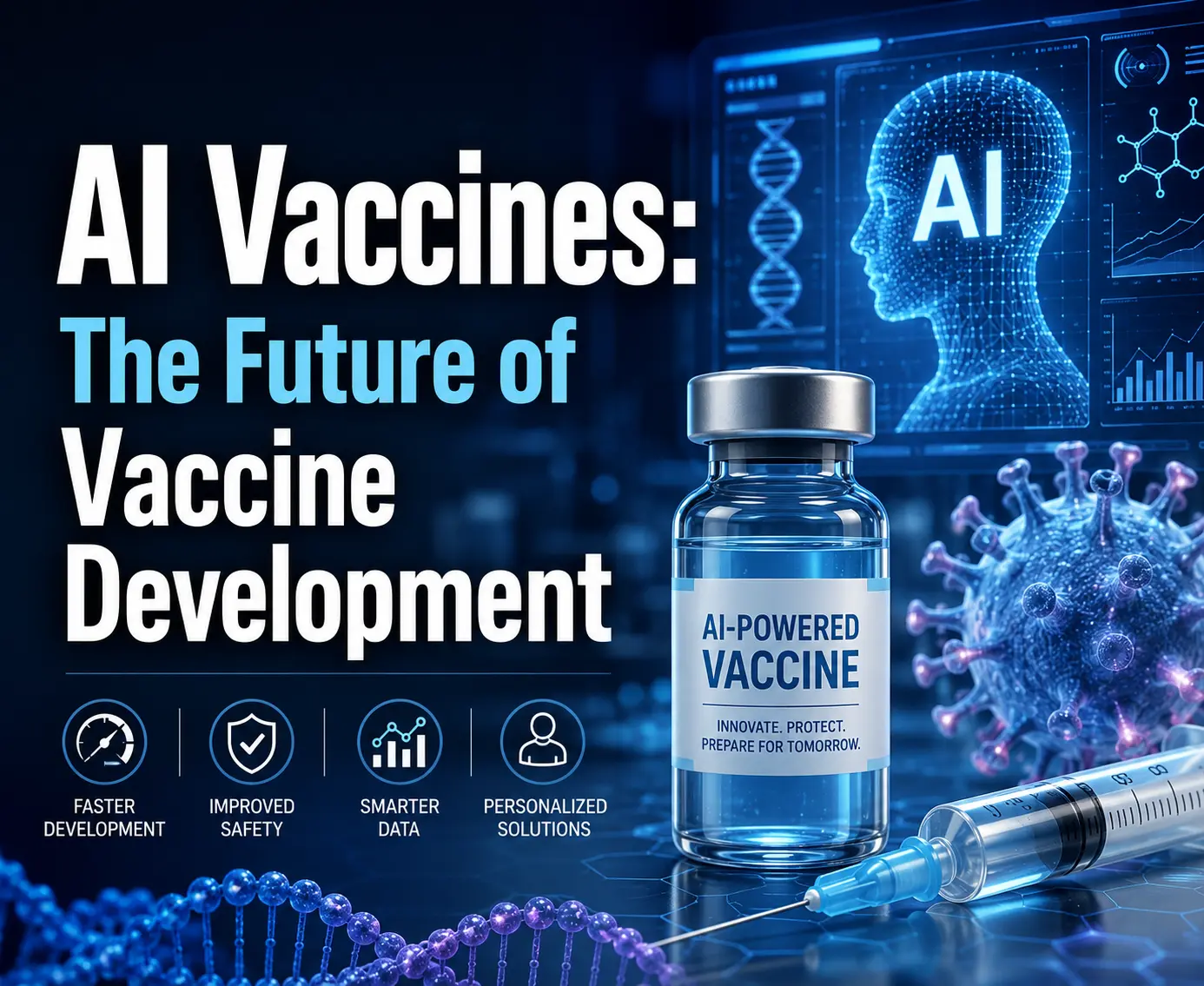
AI Vaccines: The Future of Vaccine Development
Artificial intelligence is applicable in various fields of industry. The area in which people are probably the most aware of AI being used is health care. Recently, doctors, scientists, and researchers have been using it to resolve very complicated health issues much faster. In the development of vaccines. Normally, research and development of vaccines take several years to finish and need money and resources. Although the whole development process isn’t automated and is taking a long time to finish, the use of AI in research and development of vaccines has the capability to collect a massive amount of medical data and experience from doctors and scientists in order to recognize potential vaccine candidates extremely quickly. These capabilities will accelerate vaccine development, improve efficiency, reduce research time, and help researchers produce safer vaccines.
What Are AI Vaccines?
 AI-enabled vaccines are not a class of vaccines but simply vaccines where we use some form of AI in development. An AI algorithm will examine the biological data and medical data of many samples and record patterns it notices for future use by scientists in their creation of various vaccines. They are also able to find trends about how specific viruses or pathogens spread and mutate, and then AI can work along with other algorithms of machine learning to extract data that would otherwise take humans much longer to analyze. This allows scientists to identify key structures on viruses, support vaccine research, and speed up certain testing processes. So they can be brought to the consumer much more quickly.
How AI Helps Vaccine Development
One of the most exciting advantages of AI is the fact that the computer can ingest enormous amounts of data instantaneously. Researchers working on new vaccinations must study thousands of proteins, genes, and biological samples in order to decide the direction of their work. The use of an AI based on a neural network could analyze all of these features to identify the correlations responsible for effective immunization.AI identifies promising vaccine designs and eliminates weak candidates early, reducing costly trial-and-error testing and unnecessary development expenses. AI can even help scientists to understand the results of older vaccines. This way, researchers can make informed decisions and narrow down choices much faster.
Faster Response to New Diseases
 A vital factor if a new disease occurs is the speed at which it is possible to produce vaccines. Normally, it can take years for research to develop an effective vaccine.AI can decrease the time spent identifying promising vaccine candidates, but the complete vaccine development will require long-term testing and approval. This allows researchers to understand diseases sooner and develop vaccines earlier, reducing the overall time required for research. As the population grows and travel increases worldwide, becoming faster and easier for diseases to spread, emerging infections are likely to become bigger, and therefore more important, and harder to control. AI is therefore going to play a role in controlling these infections.
Improving Vaccine Safety
Another principal matter in vaccine AI development is safety. The application of AI to early detection of safety concerns opens opportunities for predicting and avoiding the possibility of previously untested and unforeseen side effects of a new vaccine, before human testing.AI can analyze data for patterns arising from previous clinical trials or medical records, proactively alerting researchers to any potential safety issues and allowing initial modifications before substantial clinical testing. The use of AI to analyze data ranging from health records to clinic visits can also facilitate post-vaccination performance audit, allowing assessments over large samples and justifying any further survey of the clients. Vaccine Safety. AI provides a superior surveillance system to study risk and protect public health and to promote general public trust.
Personalized Vaccines
AI could additionally have applications in the future advancement of individualized vaccines. Each human contains unique DNA, and each person could respond to various vaccines in different ways. AI can combine medical and genetic records, allowing scientists to study the factors that make individuals unique. Scientists can use this pooled data to develop more effective individual vaccination programs. This may be very useful when studying difficult diseases, such as cancer. The field is still new, however, and exciting ways in which it can help to revolutionize medicine are still emerging.
Challenges of AI in Vaccine Research
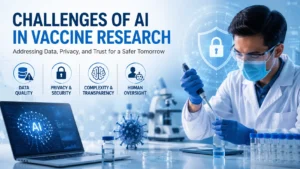 Several issues could arise that an AI program would encounter in the context of a vaccine research project. An AI program will only be able to achieve useful outcomes if the researchers feed it correct information, and scientists will be reluctant to trust a process that is too difficult to comprehend. Privacy and security issues may also be problematic as the researchers need to keep data that is extremely sensitive. Despite this, ultimately AI will not substitute human scientists or physicians. Instead, AI is simply an aid in decision-making. Researchers must solve these issues to make AI useful for vaccine research projects.
The Future of AI Vaccines
The future of AI- aided vaccine design appears very promising. With constantly evolving technology of Artificial Intelligence, researchers and scientists will have more effective tools for analyzing diseases and estimating vaccines. Artificial Intelligence can significantly reduce vaccine development time and costs while improving vaccine safety, effectiveness, and overall efficiency. Also, the use of Artificial Intelligence can contribute significantly to the global initiative to stop the possibility of future pandemics and to quicker combat responses to an outbreak. The endeavors of governments, healthcare companies, and research institutions for high AI-powered medical advancements suggest a great degree of acceptance and reliance on this technology, with current challenges notwithstanding. Businesses would achieve greater efficiency in healthcare, and the entire world could benefit from higher living standards through a symbiosis of human intelligence and sophisticated technology.
Conclusion
AI is already being utilized in vaccine production by doctors and the companies that develop them, and the reliance on the technology will only grow.AI will be able to offer considerable advantages to vaccine development research by assisting in data analysis, candidate selection, safety features, and business intelligence. Also, it can bring about fresh opportunities for patient-based medicine and enhanced disease prevention. Respectfully, in spite of a few obstacles on the road, like the quality of data and data privacy, the application of AI does make a big contribution to vaccine studies. In addition, with the further development of advanced technology, it will probably benefit AI a lot to alleviate the disease burden, especially all over the world. From the above, it is clear to see that AI will definitely revolutionize vaccine research in the future.

