
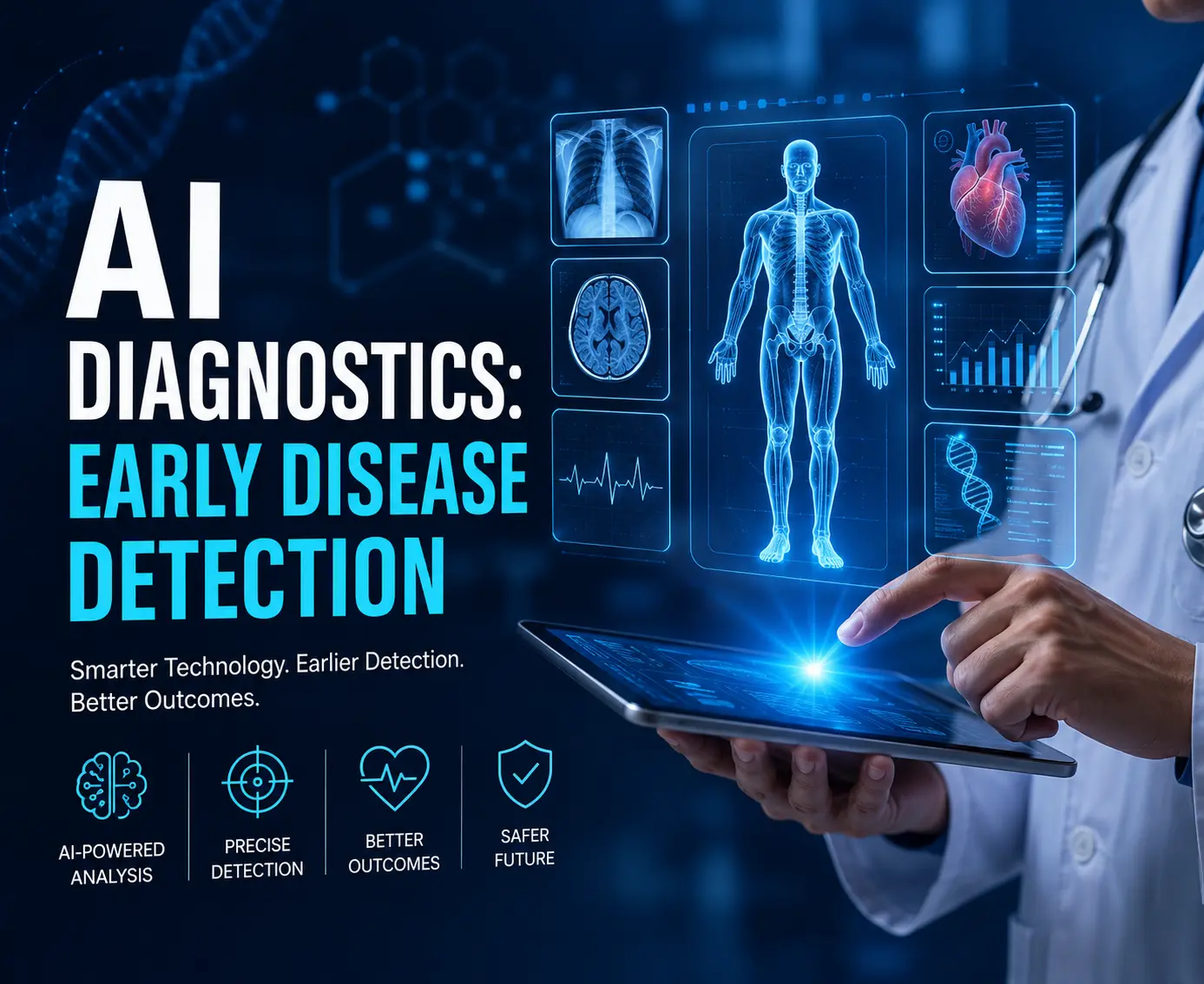
AI Diagnostics: Early Disease Detection
Every day, new developments are occurring in artificial intelligence diagnostics, aiding medical doctors in finding diseases earlier and more accurately. AIs are now able to perceive their environment and make intelligent decisions. In medicine, it can be used as a help to physicians and provide results much faster; a more accurate diagnosis of the disease means detecting an illness early before it becomes clinical. If a disease can be identified earlier, there is a chance to cure and increase the survival rate of the patient. AI systems have been developing fast in terms of implementation within hospitals and medical centers, and are probably beginning to enter the essential part in disease AI Diagnostics in the future.
What Is AI Diagnostics?
 Artificial Intelligence diagnostics is a process of AI diagnosing diseases and health conditions using Artificial Intelligence. It does this by having computers analyze large amounts of health information, including blood test results, X-rays, CT scans, MRI, patient information, etc. AI systems are trained with thousands –and sometimes even millions- of medical cases. This helps them recognize signs of diseases quickly and accurately. When a computer gets a new patient’s information, it compares it with what it has already learned and gives healthcare professionals useful insights. AI diagnostics do not substitute doctors. They are introduced into the healthcare system to help doctors make the right decisions, as AI provides more information and reduces the risk of human error. This can lead to better healthcare and faster appropriate treatment for the patients.
Why Early Disease Detection Matters
Detecting problems early on is very beneficial, especially as most diseases are easier to treat if caught early in their stages. When a disease is detected early, physicians can begin treatment before too much damage has occurred, often leading to an improved health outcome and more cost-effective treatment. For example, cancers detected in their early stages are easier to treat than more progressed cancers or tumors. The same applies to heart disease, diabetes, as well as to other diseases. Also, early detection can reduce the level of stress for the patient, since the patient can take measures early before symptoms get worse.AI can help by spotting early indicators. The doctor hasn’t got the condition yet, nor the patient for that matter, and it is still not known as a condition at this stage. This will save lives in the process.
How AI Detects Diseases Early
Detects problems earlier. If analysis of big data reveals patterns and hidden health patterns in the medical data that people or computers miss, AI can detect abnormalities and diseases earlier. Developers train AIs to recognize medical scans, pathology results, genetic makeup, and patient histories. It then applies its knowledge gained as it learns against other patients’ files to detect risks such as early signs of cancer in X-ray pictures, or abnormalities in test results that may lead to future illness. AI systems are able to search through and process masses of information within a few seconds or minutes, therefore providing a doctor with the potential to identify health issues before the disease manifests itself fully.
AI in Cancer Detection
 People all over the world experience cancer as one of the most serious diseases.The sooner the cancer is detected, the more successful the treatment. Doctors are beginning to use AI to assist with the detection of cancer early on. It does this by analyzing images of the body, taken, for example, during the scanning process, and the results of various tests, and comparing the measurements, scales, and signals to data from thousands of cases. Serial testing: AI can identify early abnormal cells that could be cancerous in a mammogram- so small that the human eye cannot see. AI helps doctors detect cancers early, improving treatment success rates.
AI and Heart Disease Detection
Heart disease is one of the most widespread diseases on earth. It is capable of resulting in death, and if recognized too late, fatal strokes and heart attacks can arise. Medical professionals could be able to identify the earliest signs of a disease, before a stroke, heart attack, or another serious medical condition occurs, with the use of AI. With blood pressure readings, scans, and health records, the patient can be diagnosed and identified as having heart problems. Early warnings from AI mean that they could guide a patient to lead a healthier lifestyle before the disease evolves; also, AI could continuously monitor and alert doctors to a significant alteration in a patient’s readings.
Benefits of AI Diagnostics
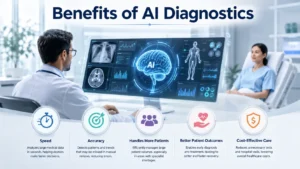 AI diagnostics has many advantages for both doctors and patients. One significant advantage is speed. AI diagnosis can go through large sets of medical data much faster than a human. This helps doctors make faster decisions. Another advantage is accuracy. It can find trends that healthcare professionals might overlook during a manual review. This minimizes diagnosis errors and improves patient care. AI diagnosis also provides an effective means of dealing with a vast influx of patients. This is useful in places where there are shortages of medical specialists. From the patient’s side, AI enables early diagnosis and treatment, reduces costs, and prevents diseases from becoming severe.
Challenges and Limitations
There are challenges to AI diagnosis systems as well. Accuracy is one; AI needs huge amounts of accurate medical data to give the best results. And if the information is incorrect or not enough, the system can give a wrong diagnosis. Hospital institutions need to ensure the right safety measures to keep the patient’s medical information private. To put AI into practice, organizations will need to follow the highest standards of data security. AI can be wrong and suggest wrong treatments, so doctors will have to verify the suggestions of AI.
The Future of AI Diagnostics
The outlook is optimistic for the use of AI in diagnostics. Advances in technology will make AI more sophisticated and enable it to analyze patients’ records more accurately and efficiently. In the not-so-distant future, AI may be a common technology in health care all over the world. Researchers constantly invent new AI innovations that might allow us to identify diseases before we even notice them today. AI-powered wearables monitor patients and detect health problems early. AI can create personalized treatment plans using each patient’s medical history and DNA data. As technology advances, healthcare experts can use advanced tools to prevent, detect, and diagnose various diseases more effectively.
Conclusion
AI diagnostics is revolutionizing healthcare. Through diagnostics and the use of AI in medicine, the practice is moving away from the reactive and becoming more proactive. AI carries out tests such as scanning images and other medical tests, finds hidden disease trends, and has a better diagnosis than any human could provide. Currently, designers are working on algorithms that will allow the AI to assist with a range of diseases, from cancer to heart disease and others. Researchers and healthcare organizations must address several challenges, especially those related to data access and data quality. AI’s benefits for doctors outweigh drawbacks, enabling a future where AI supports all healthcare areas.

