
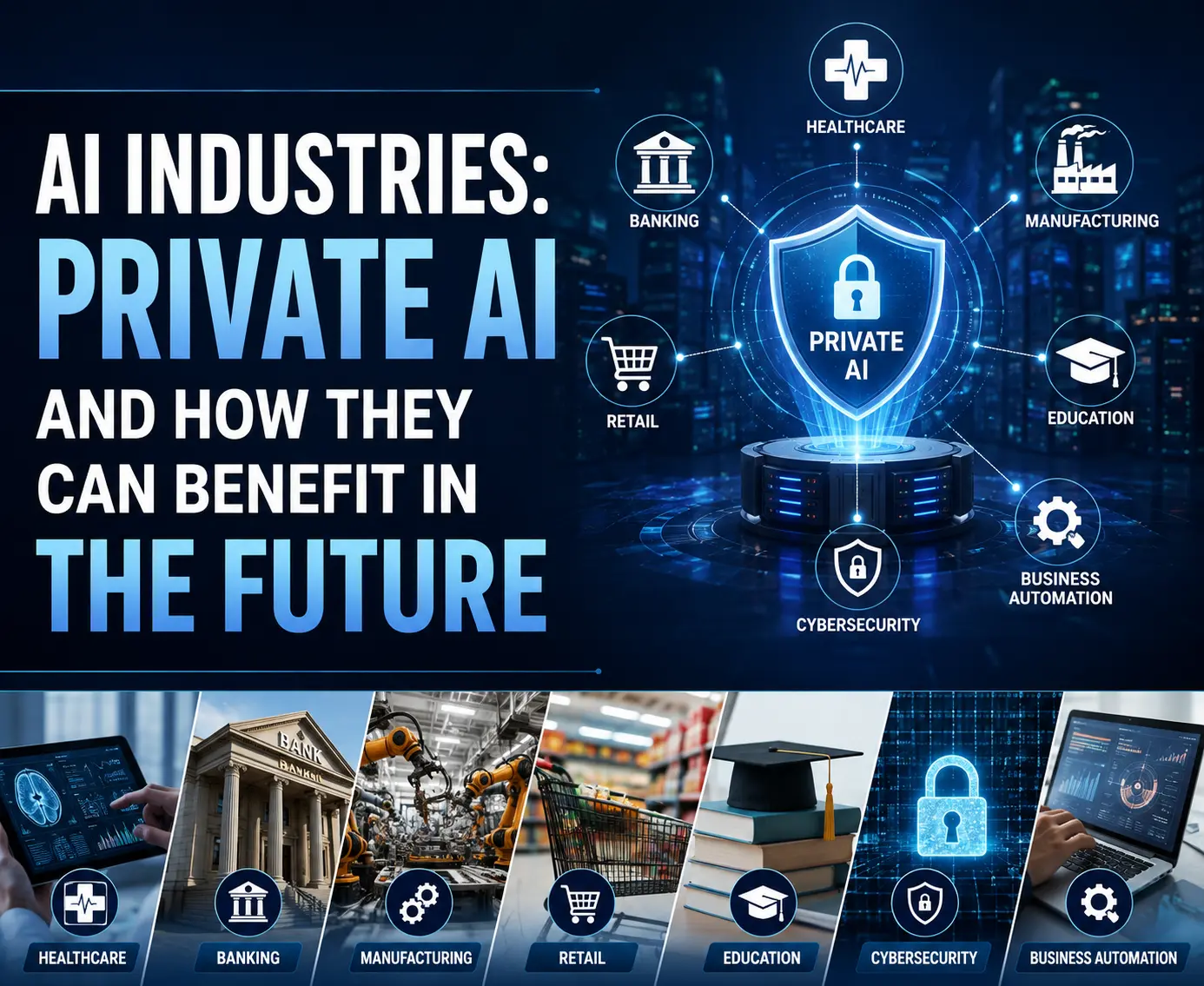
AI Industries: Private AI and How They Can Benefit in the Future
In this active business world, the application of AI is more and more popular. For instance, applying AI in handling enquiries, data analysis, automating working processes, customer relationship management, etc. Is very common. But one of the most critical issues is to what degree the corporation should disclose information to outside AI systems. This issue relates to private AI. Currently, most companies prefer to keep their private data under special types of control. Private AI industries can be useful for them to effectively utilize their private data and have more control over it. Private AI could emerge as a tool that will be used in most of the fields, like healthcare, banking, manufacturing, education, or retail.
What Is Private AI?
Private AI refers to artificial intelligence systems that operate within an organization using its own data. Instead of having an AI from a public/official website, an entity may keep its data on private cloud servers, or even another computer like this computer, rather than in the hands of a company in order to gain control over the privacy and security itself. For example, data belonging to a hospital can be used within a private AI to analyze patients’ records without actually sharing it with a public AI. An institution like a bank can make use of a private AI to analyze data while at the same time keeping control over customer data. Finally, private AI can be customized for individual companies, making it suitable for organizations that require high control over their sensitive data. With increasing awareness and adoption of data privacy, Private AI will surely be given more focus.
Why Are Businesses Moving Toward Private AI?
Organizations now have access to a considerably larger amount of data than ever; from customer data to financial data, to employee data, to product data, to business data, each of these types is flowing in much larger amounts. Businesses will naturally want to look for points where they can exploit the information, but it is just as important to care about keeping this information secure. A data leak would do immense damage to an organization’s reputation, but it could also have many legal and financial consequences. Private AI industries are one way to utilize the data generated by an organization while keeping more of it under control. Employers could leverage this capability of building AIs directed by their internal data to allow employees to go through documents, analyze data, and also perform all other menial jobs. One more advantage of private AI is precision; An organization could build an AI focused on the specific needs of the business rather than using a general-purpose solution from the public.
Private AI in Healthcare
One of the benefits of private AI is that it could be very handy for doctors and hospitals in storing and categorizing medical information and documents. There are various other benefits of private AI in healthcare, such as easy, speedy access to and filing of data, and the convenience of managing appointments. But healthcare staff should not be replaced by AI, and instead they should be supported by this technology in making or guiding their decisions. Private AI can well support healthcare professionals, and can be useful in a general daily healthcare setting.
Private AI in Banking
 Banks and other financial institutions are repositories of essential financial information such as customer accounts, loans, payments, transactions, etc. Private AI can be useful to banks and other financial organizations in many ways. It can check transactions for unusual activity and help identify potential fraud quickly. It can access and digest billions of financial data points and create reports for its users and answer any question any employee might have or any customer. Privacy can be achieved by managing the confidential data in a secure way. Otherwise, private AI can help to automate small tasks that save workers’ time during the business day. In the future, private AI industries could help banks provide faster and more secure services while protecting customer data.
Private AI in Manufacturing
Private AI can help manufacturing companies make production faster, save money, and reduce costs. The production process produces data from factory machines, supply chains, warehouses, and production lines. A private AI can analyze multiple data sources and identify faults or potential issues before things get worse. For example, a private AI can detect unusual behavior of machinery and warn the operators of a potential problem before the machinery breaks down, which can reduce downtime and maintenance costs. Private AI can also help improve product quality, estimate material requirements, and manage warehouse inventory. A private AI gives manufacturers the ability to exploit the company’s data resources while having a higher degree of control.
Private AI in Retail
 Private AI offers many opportunities for retail businesses. Retail businesses collect information about sales, products, customers, inventory, and orders. Private AI can analyze this data and help businesses make better decisions. Retailers can use private AI to predict which products customers may want to buy. It can also help prevent stock shortages of popular products. Private AI can answer customer inquiries and identify top-selling products. Business data stored within a private AI system might enable organizations to comply with more stringent privacy regulations. With the increase in online selling, there will be a proliferation of smarter recognition systems that can work without breaches privacy of customer.
Private AI in Education
Schools, colleges, and universities are also likely to gain from private AI. They hold large amounts of data about students, teachers, courses, assignments, and academic performance, which private AI can help analyze. AI tools can also help create teaching materials, summarize long texts, and develop lesson ideas. Students may benefit from personalized learning, with private AI identifying their learning needs and recommending suitable learning materials. We have a need to safeguard sensitive data, and private AIs may give us a more controllable solution. But I don’t believe that AI can ever replace teachers–in education, too much relies on more than the provision of knowledge, but on communication, understanding, motivation, adaptability, creativity, etc. Private AI could, however, help teachers save time.
Private AI and Cybersecurity
Business security is another area where private AI could be useful. The types of attacks users could potentially face are hacking, viruses, malware, account hacking, etc. Private AI could analyze data in real time, identify suspicious behaviour, and then support security researchers with investigating security threats, all while maintaining privacy. Private AI could be used by employees for security alerts (to understand them) and for finding documentation. Security data stored in a secure environment could give organisations greater control over high-impact sensitive information. While private AI cannot protect against every cyber attack, it can support users in reacting more quickly and therefore is a potentially valuable security tool.
Private AI for Everyday Business Tasks
Private AI can also support common workplace tasks. For instance, many employees spend a significant amount of time finding data, writing reports, sorting information, and handling repetitive inquiries. A private AI assistant is also a means to find information automatically, create management summaries, or answer questions based on already approved information targeted at work. Staff may ask questions such as: Maybe what is the policy on a delay? Or, you can just give me the executive summary of this report. AI enables a company to automate its boring jobs and have its workers read, think, and make decisions.
Challenges of Private AI
Although private AI has its benefits, it is not a miracle worker. Private AI can also be expensive and difficult to manage. Small companies may not have the financial resources or skilled employees needed to build and manage advanced private AI systems. The requirements for the data fed into the system also need to be considered. If the data is of low quality and imprecise, the results from the AI system will be inaccurate, resulting in unreliable outputs. Moreover, the provision of high-quality security and safeguards (against hackers) is crucial, as well as the training of staff, so that the workers become responsible for using the AI systems and are aware of their shortcomings. So, firms need to identify their needs and adopt appropriate solutions based on their budgets, data, and security issues.
What Will the Future of Private AI Look Like?
Opportunities exist for private AI, as potential customers want to enjoy the advantages of using AI and greater control of their own data and information. As machine learning becomes more efficient, organizations may find it easier to adopt private AI. Smaller AI models could enable some organizations to operate effective AI applications with less compute power. Private cloud services could make advanced AI more accessible to organizations that cannot fully develop these systems in-house. Over the next few years, organizations could utilize private AI for in-house assistants, data analysis, security and privacy, customer service, automation, and decision support. More industries may adopt private AI as they see real benefits. However, the most successful businesses won’t embrace AI simply for the novelty of it but concentrate on the use cases that save time and resources, secure data, and benefit people.
Conclusion
I believe that private AI has many utilitaries to business in the coming years. Private AI lets companies use AI while maintaining greater control over sensitive information. For example, hospitals can apply private AI to keep track of patients’ records, banks can utilize it for fraud detection, and manufacturers can enhance production. Private AI can also help retailers analyze customer data and support teachers and students in education. Besides, private AI industries can help to automate redundant jobs and raise the security of the system. However, before entering into private AI adoption, companies should evaluate the costs, data quality, security, and training of staff. Companies would gain a lot by saving time and protecting data quality, as well as by increasing efficiency and creating value through private AI.

