
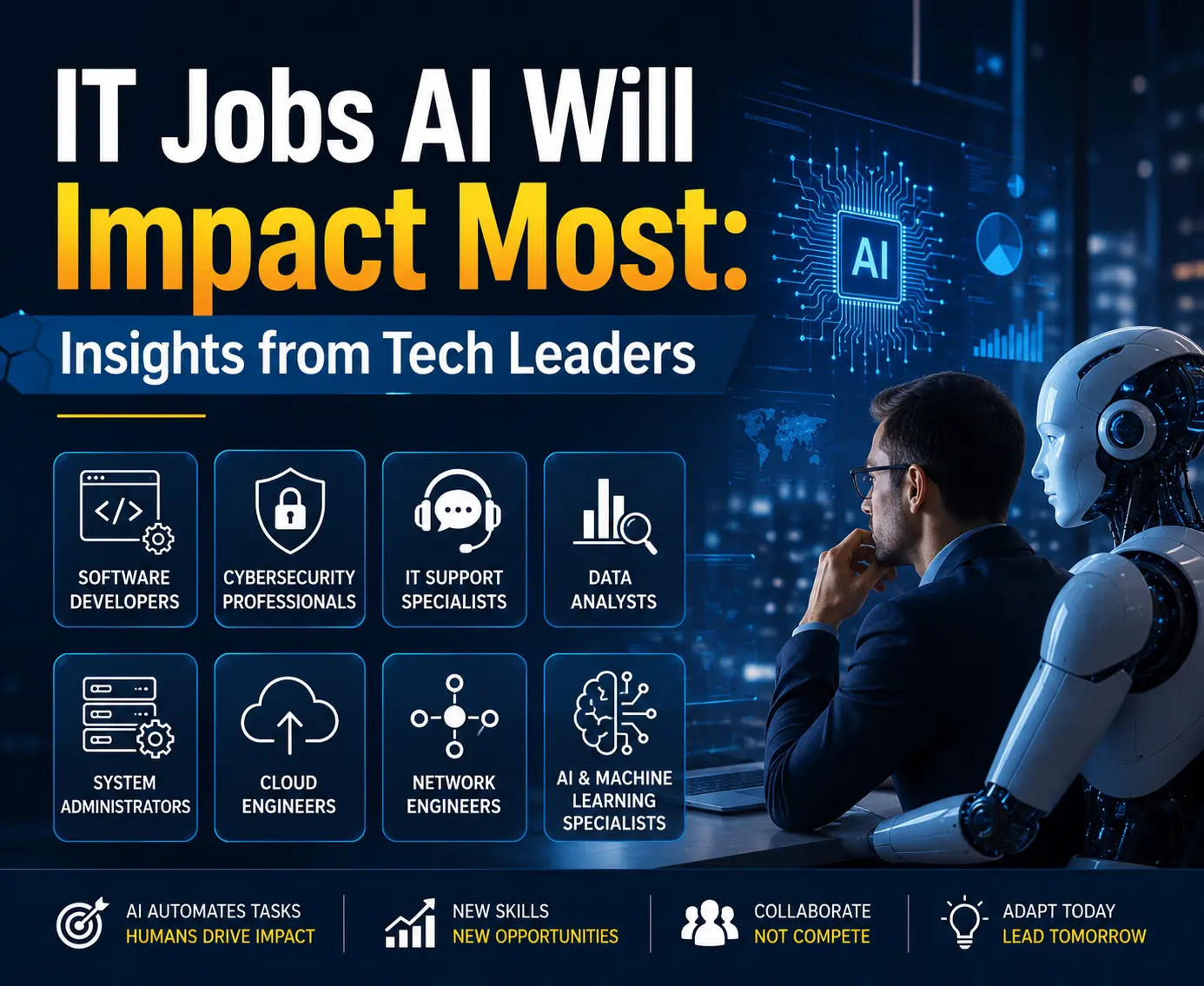
IT Jobs AI Will Impact Most: Insights from Tech Leaders
Artificial intelligence is revolutionizing the IT industry faster than ever before, as AI can write code, identify security gaps, analyze data, and perform a number of the boring, mundane tasks that everyday life involves. However, not every IT worker will be made redundant; we are simply witnessing a shift in how we work, changing how people work and how IT job roles are evolving. Technology leaders believe that the only way for the workforce to thrive in the future is to work with AI and therefore automate the said mundane activities. And this leaves rather a lot of questions. Which IT jobs will AI impact the most? What are the tech leaders saying? What should students, beginners, and more experienced working professionals do so that their careers can be successful in the future world of technology? We have some insights.
Software Developers
 AI is currently one of the areas of IT having the biggest impact. Modern AI coding assistants, or program help software, are capable of generating code, providing hints to improve, fixing minor errors, and explaining concepts. They boost developer productivity and eliminate boring jobs. The remaining work will still be done by humans as it currently requires a deep understanding of their business, users’ needs, and complex system architecture. According to top executives, Developers are being asked to deliver less code but solve more complex problems. Developers who understand AI tools will become more efficient than those who don’t adopt the technology. Fundamentals of programming, software design, testing, and communication skills will still be necessary, as AI is good when developers know what they want and analyze each output carefully before launching.
Cybersecurity Professionals
Cybersecurity is in the midst of a revolution. As newer, state-of-the-art technologies are emerging, like AI, AI can constantly monitor a network, detecting any anomalies, and stopping the incident, without human awareness. AI can evaluate tens of thousands of security incidents a day.AI can discover the security patterns that can inform the security administrator about cyber attacks, so that they can respond rapidly without suffering damage. Nevertheless, the hackers and other malefactors are just starting to use such powerful algorithms for hybrid attacks. The industry expects to see more cybersecurity specialists working in tandem with AI than battling against it. Security experts will probably study the events, perform the long-term planning, and decide on the right policies, while machines will handle the mundane part 24/7. Security professionals will need strong cybersecurity knowledge along with AI skills.
IT Support Specialists
 AI is also changing the nature of IT jobs by automating routine customer support tasks. Chatbots or virtual assistants equipped with artificial intelligence will be able to offer customers round-the-clock and on-the-fly support for queries like answering common questions or providing assistance in reset procedures. Support workers can focus on resolving more pressing issues, thus shortening queues, enhancing satisfaction, and leveraging their deep understanding of human interaction and their specialized skills in hardware and software to assist with complex and individual technical problems. The well-versed, highly competent IT support worker will continue to be an essential component in the field; workers with strong interpersonal skills, a strong technical background, and skills in solving unique technical problems are an irreplaceable asset to the industry.
Data Analysts
Within data analytics, we are seeing huge changes; this is a role that machines can perform in minutes. AI applications can create reports, detect trends, generate graphs and answer business questions using natural language. This makes them very efficient, and companies can make quick business decisions. But without the human element, AI is incapable of understanding what a business strategy is or what insights are relevant. The overwhelming feeling among technology executives is that analysts will move from gathering and cleaning data to spending more time on finding business insights and opportunities, and formulating the recommended action. Logical thought process, business experience, and good communication will be more important than ever, and the professionals who can use data and AI tools effectively will produce increasingly more insightful findings and enable better decision-making.
System Administrators
System administrators, individuals who maintain servers, networks, cloud services, and systems infrastructure, will be assisted by AI in many of their tasks. By continually monitoring the systems’ operation, predicting hardware breakdowns, forecasting maintenance requirements, and maximizing efficiency, automation will improve system reliability and reduce disruptions. Future system administrators will oversee, as opposed to directly control, an AI-enabled infrastructure. Rather than spending time reviewing logs or diagnostics, computer engineers will process the recommendations of the AI and think about how to make next year’s system better. While being familiar with each of these areas will be more and more important to individuals, it will still be knowledge and expertise that business managers have called upon to make business decisions, address complex technical issues, and support business-critical applications.
Cloud Engineers
Cloud engineering is a relatively new discipline in the sense that more organizations are migrating their application and data to the cloud. AI benefits cloud engineers by automating resource allocation, giving early warnings about system health, limiting operational costs and anticipating future needs of the infrastructure. Such enhancements enable organizations to offer better cloud services. Industry leaders think cloud engineers will move away from administering various routine operations to designing intelligent, automated cloud architectures that are powered by AI. Cloud engineers need to possess considerable knowledge and experience with cloud platforms, infrastructure automation, cybersecurity and cloud AI services provided by the three major cloud providers. It is because the technical requirements for every organization will have their own unique specializations, and AI will not be aware of them. AI-specialized cloud engineers will become very busy as many more companies develop their digital business.
Network Engineers
 A network engineer looks after and manages computers, servers, and other hardware in communications networks. However, fast, smart AI systems will soon have some network operations functions delegated to them, such as identifying bottlenecks, forecasting failures, controlling network traffic, and suggesting ways to overcome such problems. This lowers unplanned outages and means human engineers spend less time on review and monitoring and more time configuring high-end network systems for cloud and AI applications. Future knowledge requirements include software-defined networking, automation, defenses against cyberattacks, and various network monitoring, reporting, and Optimization AI tools. Experienced engineers will keep their jobs making crucial design choices, planning growth expansion, and managing unexpected problems. AI will become a reliable assistant.
AI and Machine Learning Specialists
In the midst of job losses, the role of AI has spurred the creation of new jobs. AI and ML experts build, train, test, and improve AI systems that businesses use, and demand for AI and ML skills is proliferating into new sectors as more companies adopt AI. Chief technology officers (CTOs) believe that roles will be amongst the fastest-growing IT roles as organizations need professionals who have both a working knowledge of algorithms and data management, the ethical concerns and correct use of AI, be responsible for legal and regulatory compliance, and be a conduit between data scientists, software engineers and business teams. Careers in artificial intelligence and machine learning demand a focus on learning throughout your entire life due to the evolution of technologies. Strong mathematical, programming, and problem-solving skills should be given attention to provide good career-long prospects.
Skills That Will Matter Most
This is how big technology companies foresee that they will win in the future – be skillful instead of just being professional with a certain job title. While AI could do lots of the jobs related to robots, AI cannot take the place of leaders, creativity, critical thinking, interpersonal skills, and ethics. IT experts should start to love AI, rather than freak out. Investment in the improvement of languages, cloud computing, security, data mining, and communication skills would be a wise decision. Since the evolution of new technologies is always faster, they will definitely need talented staff to cope with the challenges of the future. Take advantage of the present moment and get ready for the AI era.
Conclusion
AI is revolutionizing the IT industry. It is not destroying all IT jobs. AI is simply a tool for IT professionals, transforming but not destroying jobs. AI automates repetitive tasks, which could make staff available for other more valuable projects. The AI specialists, together with technology users from non-AI fields, would bring several new jobs into existence. However, there will always be a high demand for software programmers, security analysts, IT services and support specialists, data analysts, cloud engineers, network engineers and system administrators. Managers and staff will always find a way to work around new technology, according to senior leaders, and the qualities of human imagination, problem-solving, communication, and decision-making will remain just as important. Embrace AI, learn a new skill and work with the technology as a knowledgeable colleague; early adopters will be prepared for the future of the IT sector.

