
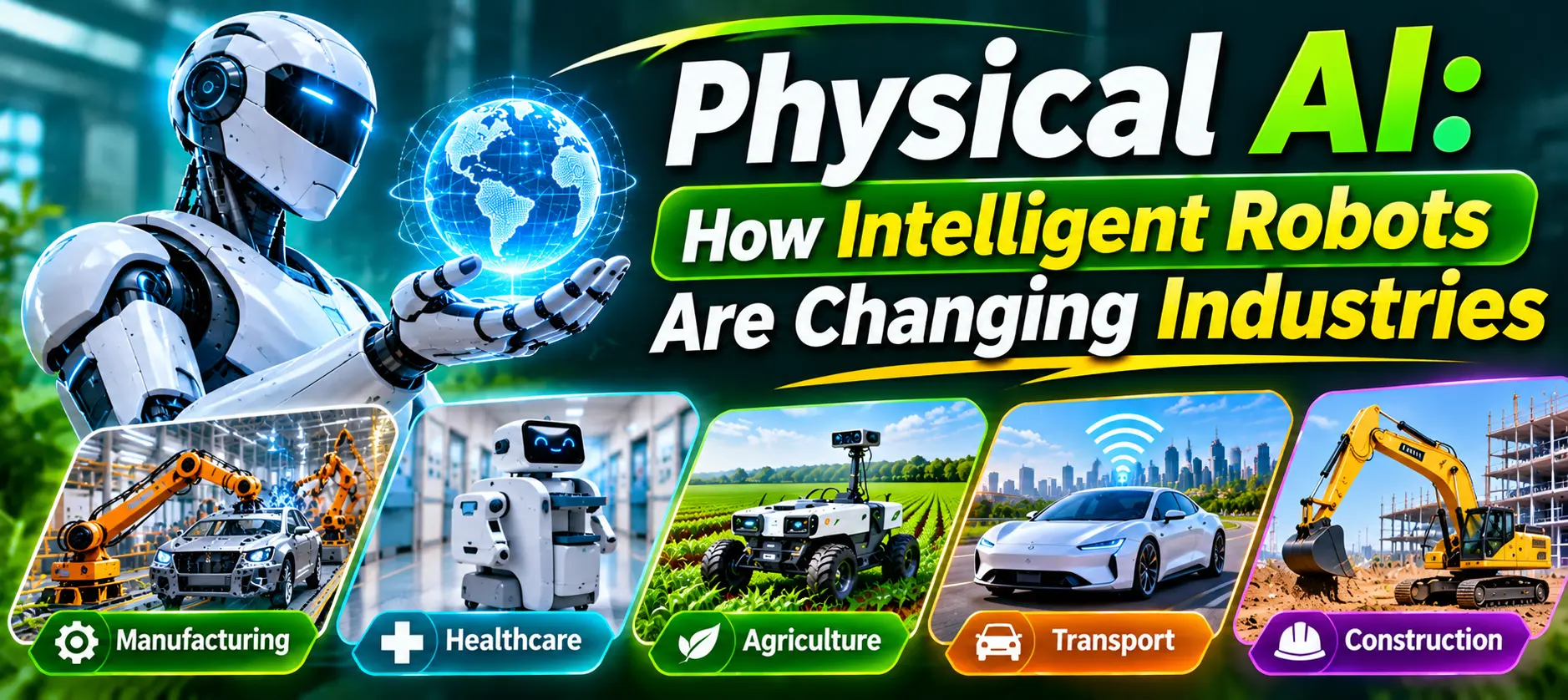
Physical AI: How Intelligent Robots Are Changing Industries
How is the world being changed by Artificial Intelligence? Robots are becoming much smarter every day. AI-powered robots are not limited to factories or robotic process automation. While AI-driven robots can observe, decide, and act, using information they’ve collected Physical AI refers only to the application of AI in the physical world. Physical AI is beginning to make a difference in the manufacturing, healthcare, agriculture, transport, and construction industries. Businesses are experimenting with how smart robots can make the workplace safer, more productive, and more accurate. Although physical robots powered by AI can help create a better future by decreasing human errors, there are risks that come along with them, such as the cost, safe use, and job loss for humans.
What Is Physical AI?
 What is physical AI? Physical AI empowers the machine to recognize and take in information from the physical world. Robots, autonomous cars, flying and land-based drones, and other devices that interact directly with people and physical objects can use this technology. Unlike a conversational bot, which simply takes some text and makes sense of it and offers a response, your physical AI could have various vision, sensing, and audio devices. It could have the ability to plan, navigate, move, grip, and see. For example, a robot in a warehouse could recognise a box on a shelf and move it to the dock. Physical AI uses computers, software, and sensing devices along with actuators. It is not just one AI device but a fundamental part of allowing autonomous physical interaction.
How Is Physical AI Different?
Physical AI can respond to its environment. Traditional machines will often carry out the same actions if given the same input. But physical AI can change as new information comes in. If someone moves a box to a different location, an AI-powered robot can adapt and pick it up using a new approach. Not every robot will be able to grasp everything as humans do, but many will work best in worlds that have well-defined rules. Physical AI links sensing, thinking, and acting to allow robots to react to their environments.
How Does Physical AI Work?
An AI system that is physical generally operates by sensing, understanding, planning, and acting. Sensors, such as cameras, collect the data. This data will be analyzed by algorithms on the computer so the robot can decide what actions it needs to take. The action is performed by the motors, wheels, or arms of the robot. Data will then be collected by the sensors to see how the system moved, so that it can change its movements. Other methods can be used, for example, by the use of maps, simulations, and information being shared from one system to another. For the robot to work accurately, the hardware, software, power system, communication system, and safety system all have to work with each other.
How Are Intelligent Robots Trained?
 Training makes the robot learn certain tasks. Developers train robots using either real-world data or computer-simulated data. Simulation allows us to teach robots to avoid bumping into objects in the warehouse or factory; this saves us time and allows the teams to test dangerous simulations without incurring danger. However, no simulation is perfect, so every situation in the virtual world will differ slightly from the real world. For instance, the actual floor could be less grippy, or the lighting may vary. Because simulations can never be an exact reflection of reality, developers need to verify all robots in real-world environments before giving them any important tasks. The trainers have to regularly verify the robot is still doing its job, change the programming, and put procedures in place when the unexpected occurs.
Physical AI in Manufacturing
One of the most popular and impactful uses of robotics is within industry. Robots are used today for building cars, welding, painting, moving things around, and quality inspection. With Physical AI, some of that equipment can be more flexible and have more knowledge about what is being done, with small modifications taking place along the production line. The International Federation of Robotics reported that companies worldwide installed 542,000 new industrial robots in 2024. However, this figure does not show how many of these robots used Physical AI. Humans continue to operate the production system and are the ones controlling the robots, and the robots contribute to the repairing, inspecting, and quality control. Infrastructures will have to be designed and managed. The industry can combine infrastructure and robots to increase safety, harmonize processes, and facilitate production.
Physical AI in Warehouses
 In a warehouse, companies use robots to put things away, rotate shelves, sort items, and assist packers. They also pre-program some robots to follow a set route. Others have cameras and sensors so they can identify other staff and objects. In November 2025, SAP announced a pilot project with Bosch and Aimbo AG, using a humanoid robot named Anigon to perform warehouse tasks. The robot retrieved real-time order and stock information from the SAP system to perform its tasks. This shows how a robot can blend the world of technology with the physical world; however, this was a pilot project and wouldn’t mean a completely hands-free warehouse. Staff would still need to monitor stock, investigate discrepancies, maintain equipment, and ensure security. Robots can take over the repetitive physical tasks, so warehouse staff can concentrate on other duties.
Physical AI in Healthcare
Robots are also used to assist hospital staff with repetitive tasks that do not require medical knowledge. Diligent’s Moxi robots can deliver items and equipment through hospital corridors, and several hospitals already use them. The company says the robot has now carried out more than 1.25 million deliveries at more than 25 hospital locations. The robot demonstrates that it can support the medical team rather than replace it. Medical professionals, including doctors and nurses, bring expertise and a personal touch to healthcare by communicating with and caring for patients. Hospitals must protect highly confidential patient data. Robots must be designed to protect hospital staff and patients from potential harm. These delivery robots could ultimately benefit and save time in the healthcare and care sector.
Physical AI in Agriculture
Physical AI can monitor, test, and assist with certain field processes. Using sensors and cameras on top of robots, tractors, and drones, growers can gain information about plant health, soil quality, and field conditions. The AI programmes can help the farmers by showing them areas that need attention. Farmers can also use robots to pull up weeds and pick crops. This can be challenging as there are many factors to consider, including different shapes and sizes of plants, uneven ground, dust, rain, and changing light conditions. These can make the robots much harder to operate compared to those used in factories. The cost is an issue, especially considering smaller farms. Farmers need to select technology that suits their crops, local weather, and farm size and can be repaired locally.
Physical AI in Transport and Construction
Physical AI can help with transport, construction, and inspection. Detection of nearby vehicles, lane change warnings, and brake activation are driver assistance systems. They are not driverless vehicles. The driver needs to pay attention all the time and follow the rules of the road. Construction workers can use robots and intelligent machines to build and inspect buildings. They can also move equipment in difficult or dangerous locations. Drones can fly over an area and map it. The roads and construction zones can change suddenly. The weather, individuals, automobiles, as well as things influence the area and also make the location dangerous. Humans have to screen these devices very carefully, set up boundaries for the area, and also run it safely.
Benefits of Physical AI
There are some benefits of physical AI. Robots can perform physically demanding tasks, including heavy, boring, or dangerous jobs. They can perform precise movements for long periods of time if well maintained. In some circumstances, it could improve output, order fulfillment, and equipment lifespan. Robots could potentially collect information which could prove useful in supporting managers to get a grip on what’s going on. However, the company may not achieve these benefits because it must decide whether investing time, training, and funds will provide worthwhile results. There must also be a specific issue that needs solving at the start. Projects will be successful by helping staff or improving a process.
Challenges and Risks of Physical AI
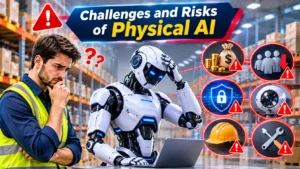 The purchase and maintenance of AI robots in the real world is expensive, and workers may be worried about losing their jobs. Sensors may be out of date, the internet may require an upgrade, and they would need other safety features. The robot might get out of order, the sensors may become damaged, or the environment the robots are working in might alter. Firms will have to secure their systems and data from cyberattacks and think about how to respond to people who worry about their effect on employment – training and keeping people up to date, for instance. When human lives are at risk, it must be humans making the calls.
The Future of Physical AI
Robot systems should work well with the systems a company already uses. They also need good training data and tests to allow them to do the jobs safely. At first, companies will use robots for specific tasks. Developers assign each robot a specific task. Over time, robots may perform more tasks with the help of better sensors that allow them to understand their surroundings. The help of smarter AI can also allow the robots to make better decisions. Safe hardware and regular testing can also help prevent mistakes. Decide what the key decisions are to enable you to use the best tech. Risks can be diminished with rehearsal and planning.
Conclusion
The potential of Physical AI looks promising because it is constantly changing and growing into new domains. Right now, you can employ them on building sites, in offices, warehouses, the medical industry, and even in the agricultural world. Physical AI robots can work in many industries and help people complete repetitive tasks. But they tend to be costly to run and even less safe for workers working around them. Intelligent robots cannot substitute human thinking, feelings, and creativity. It will be humans plus smart machines in the future.

