
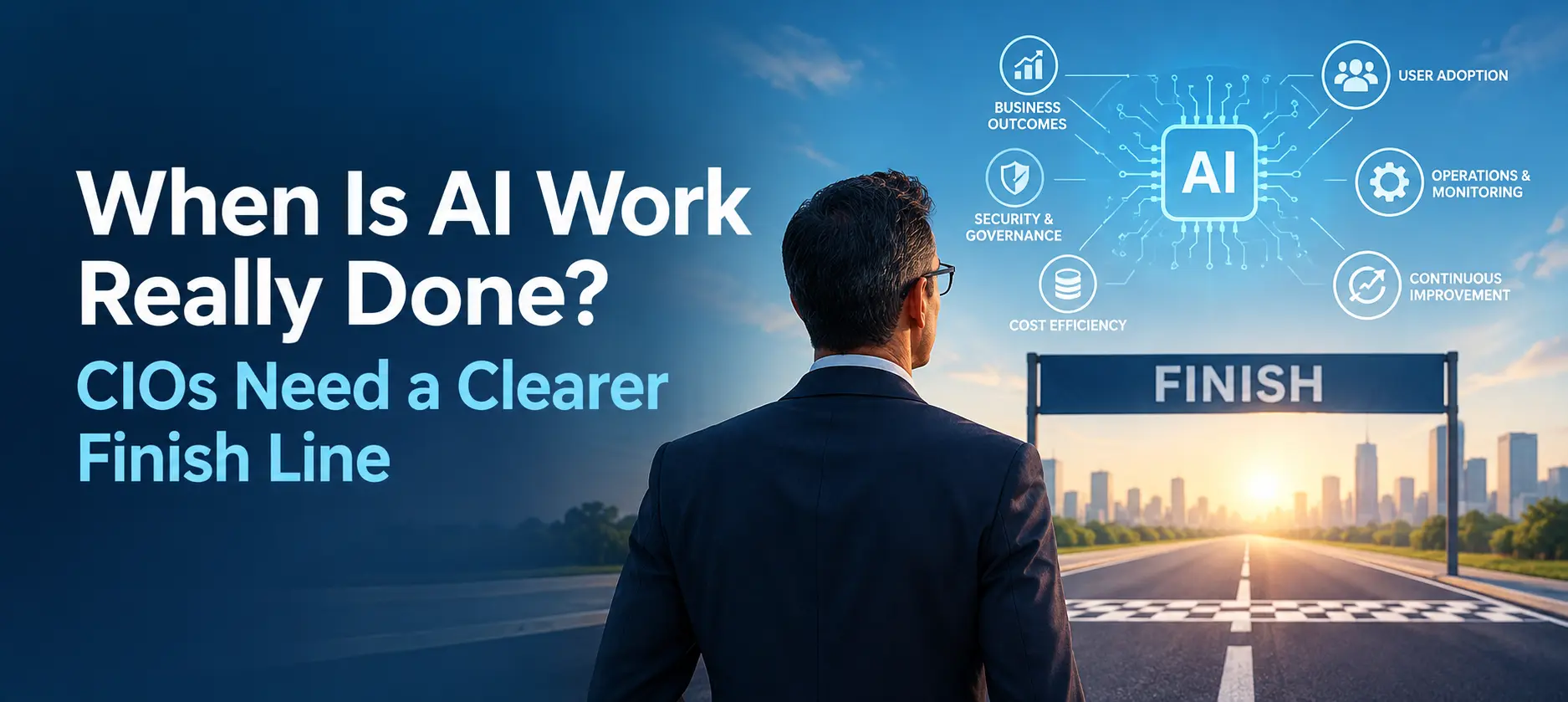
When Is AI Work Really Done? CIOs Need a Clearer Finish Line
As the role of artificial intelligence begins to evolve beyond a niche exploration to one of business priority, CIOs will be motivated to further their utilization of AI, raise productivity, reduce costs, and achieve demonstrable results. With that said, there remains no agreement on what it means for an AI-related initiative to be complete.
Technology projects that are considered “traditional” will most often be completed when there is a clear endpoint to the work being done. For example, a new software system has been implemented; the system has gone live; users have been trained; and the project moves forward as part of an organization’s day-to-day operations. However, AI projects differ from traditional technology projects. AI models continually evolve as new data becomes available, user behavior continues to develop, and the performance of the AI model may change over time.
This creates a dilemma for CIOs. If the AI initiative is never-ending, companies continue to invest heavily without realizing if they are getting value for their money. The key to the problem lies in not abandoning the improvement of AI but setting a finish line for the project. This will enable firms to rein in expenses, get results, control risks, and ensure that the successful projects are sustained in the long run.
Why AI Projects Are Difficult to Finish
 AI solutions are rarely set in stone. A conventional application doesn’t change its behavior after launch, but an AI solution continues learning and adapting over time as its data, model, users, or environment change.
For example, an AI-powered helpdesk solution that was able to answer 90% of frequently asked questions correctly last year may know nothing about this year’s frequently asked questions. The company’s product lineup changes, new policies are issued, and new regulations come into place. These changing conditions require the AI solution to be monitored and upgraded constantly.
That does not necessarily mean that the CIO’s initial project ended before it was truly finished – it only means that work on the AI project rarely stops, because there is always room for improvement. If CIOs do not keep this in mind, every AI project has the potential to become an endless series of initiatives.
Define the Business Outcome First
The clearest AI finish line starts with the business problem. Organizations should avoid defining success simply as “launch an AI solution.” Deployment is an activity, not an outcome.
Instead, CIOs should establish measurable objectives such as:
- Reduce customer service costs by 20%.
- Cut document-processing time by 50%.
- Increase sales conversion rates by 10%.
- Reduce software development time by 25%.
- Improve fraud detection accuracy.
- Help employees find internal information faster.
These goals provide a realistic definition of success. If an AI system meets the agreed business goals and satisfies the technical and security requirements, then the system can be considered successful. The phrasing also prevents the AI team from bloatware — adding unnecessary features just because they were possible.
Establish Clear Success Metrics
AI projects demand a different set of metrics than traditional project-management practices. CIOs should evaluate an AI project’s technical performance, business benefits, user adoption, and operational efficacy. It is critical to define measurements for technical performance, such as the model’s accuracy, the quality of responses, processing speed, cost per use, adoption rates, customer satisfaction, and improvement in productivity.
In a more complex structure, such as generative AI, evaluation might be more complicated. For instance, a chatbot can use correct grammar but provide incorrect information. In this case, it can be concluded that the effectiveness, relevance, accuracy, security, and other criteria should be considered when developing a system. The critical aspect is to create a list of indicators and show that a product is suitable for release. Otherwise, the team will constantly improve the program and discuss its effectiveness.
Create a Definition of Done for AI
Every AI initiative should have a documented Definition of Done. This should specify the conditions that must be satisfied before the project moves from development into operations.
A practical Definition of Done could include:
- The AI solution meets agreed performance targets.
- Business objectives have been achieved or validated.
- Security testing has been completed.
- Privacy requirements have been addressed.
- Regulatory and compliance reviews are complete.
- Human oversight procedures are established.
- Users have received appropriate training.
- Monitoring and alerting systems are active.
- Ownership has been transferred to an operational team.
- Documentation and support procedures are complete.
This framework creates a tangible finish line. More importantly, it creates accountability. Everyone involved understands what must happen before the project is considered complete.
Separate Development From Operations
 One of the biggest errors that organizations make is to include everything that improves the AI system within the initial project. Beyond a certain point — when the solution is production-ready — the AI requires an owner, someone who will be responsible for day-to-day operations. Of course, developers may continue to work on the model, but looking after an AI system should be considered an operational expense, like any other critical technology infrastructure.
The operations side of AI should be governed by the same principles as other operational work in your organization. This means that the project to develop the AI solution should conclude once the solution is production-ready. From that point forward, enhancements to the system should be considered changes to the product and handled through a product roadmap or improvement initiatives. In this way, CIOs can ensure that they are in control of costs and responsibilities for the AI systems within the organization.
AI Requires Continuous Monitoring
A clear end line does not indicate the end of the road for organizations using an AI system. The need for continued management of an AI system is driven by the fact that the systems exist and operate in a dynamic environment. A key aspect of model management is model drift, which refers to the fact that the data or patterns that were used to train the model change over time, resulting in model performance deterioration.
In addition, there are some unique challenges for generative AI: different behaviors of models after updates, changes in external data used by models, and changes in user behavior.
Organizations should therefore monitor:
- Model performance
- Data quality
- Accuracy and reliability
- Security threats
- Unexpected outputs
- User feedback
- Cost and resource consumption
- Compliance risks
- Changes in business requirements
The important distinction is that monitoring is an operational responsibility, not evidence that the original project is incomplete.
Know When Human Oversight Is Required
AI shouldn’t control anything that could have even the slightest negative impact on someone or something else. Therefore, if you’re thinking about using AI to make decisions regarding jobs, money, health, insurance, or law, reconsider. You probably need more than an inside writing assistant. CIOs need to establish clear boundaries as to where humans need to maintain control. One method of establishing these boundaries is by creating a risk matrix that categorizes different AI decisions based on how risky they are.
Decisions that carry little to no risk can be made entirely by AI, while those that involve some risk would require human intervention at the point of uncertainty, and high-risk decisions would require human approval before taking place. This way we aren’t eliminating human input on AI decisions; we’re merely setting limitations as to when human input is necessary and when it isn’t.
Security and Governance Must Be Part of the Finish Line
AI projects can create new security and governance issues. AI applications get information from prompts, documents, APIs, or related applications. Employees can also make shadow AI systems using unapproved tools. Before the project is finalized, CIOs should make sure that there are controls in place to manage the application, including access control, data security, identity management, logging and auditing procedures, model governance, vendor control, and incident response. It is critical to establish ownership of the program. If no one owns a system after it goes live, responsibilities can be murky and hard to sort out.
Calculate the Total Cost of AI
AI projects can look cheap in development time but get expensive when scaled. Costs relating to cloud, model usage, data storage, API, security, monitoring, human evaluation, and maintenance can all add up. CIOs should define a financial success metric for the project.
For example, an AI-powered assistant that saves thousands of hours of people’s time per year could easily have negative ROI if upkeep eats up too much of that time. A clear finish line includes a review of the projected return. The organization needs to know that the system is not just effective but a good financial decision.
Avoid the “Pilot Forever” Problem
Many organizations become trapped in endless AI pilots. A team launches a small experiment, demonstrates promising results, and receives approval for another experiment. Months later, the organization has dozens of AI pilots but very few production systems. This happens partly because there is no clear transition process. Every pilot should have a defined decision point.
At the end of the experiment, leaders should decide whether to:
- Scale the solution.
- Modify and retest it.
- Keep it as a limited deployment.
- Integrate it into another system.
- Or shut it down.
Stopping an unsuccessful AI experiment is not failure. It is responsible technology management.
The real failure is continuing to spend resources on a project that has no credible path to business value.
Treat AI as a Product After the Project Ends
 Once put into production, an AI system should be considered a product that requires maintenance like any other business product. There is a product owner, users, quality standards, a product development plan, and a life cycle. This approach is especially useful for enterprise AI because there will be users who can request additional capabilities.
For example, if you have an AI knowledge base that has been implemented as a product, its users will ask to connect the system to external databases and make it multilingual. These requests should be prioritized and formally examined in the context of the product’s strategic goals. A product-oriented approach to AI ensures that scope creep is avoided.
Build an AI Lifecycle
CIOs can design a standard lifecycle for the development of AI initiatives:
Idea > Experiment > Validation > Production > Operational Management > Improvement > Retirement
There must be entrance and exit criteria for each stage. The organization asks the question, “Can this technology solve the problem?” during experiments. The team addresses such issues as performance, security, costs, and user acceptance during validation. The production stage is reached when an AI system is ready for operations.
Operational management deals with operations and monitoring issues. Next, improvement involves iterative enhancement. Finally, the initiative is retired at some point because it loses its relevance or becomes obsolete. It is much easier to define the notion of done using this lifecycle.
The CIO’s Role Is to Define the Boundary
CIO’s don’t have to personally configure every AI model, and the true focus of the CIO’s job is on the organization and management of the work around AI, including who owns it, how it will be funded, the risks accepted, and how success will be measured, along with governance and operational requirements.
The CIO should ask several fundamental questions:
What problem are we solving?
How will we measure success?
What conditions must be met before launch?
Who owns the system after deployment?
What monitoring is required?
How much are we willing to spend?
When should we stop investing?
These questions turn AI from an open-ended technology experiment into a manageable business initiative.
Conclusion
The process of building and maintaining an AI system is seldom completed. There will be constant opportunities for models to improve; there will be constant changes to the data that train those models; and there will be constant identification by users of new applications. However, this does not imply that all AI projects may proceed without limit.
The CIO needs to have a clearer end point to work toward that is based on business results, technical capabilities, security posture, governance framework, cost efficiency, and operational maturity. At the time all of the above requirements are met, the project will move into its regular operational state or into product management.
Organizations that have reached a high level of maturity in their use of artificial intelligence will evaluate the effectiveness of their experimentation process not on the number of experiments they conduct, but rather on how successfully each experiment is transformed into a stable, functional, and long-term solution.
The question is therefore not whether AI can ever be finished. The better question is whether the organization has achieved the outcome it set out to achieve—and whether the system is ready to stand on its own.
That is the finish line CIOs need.

