
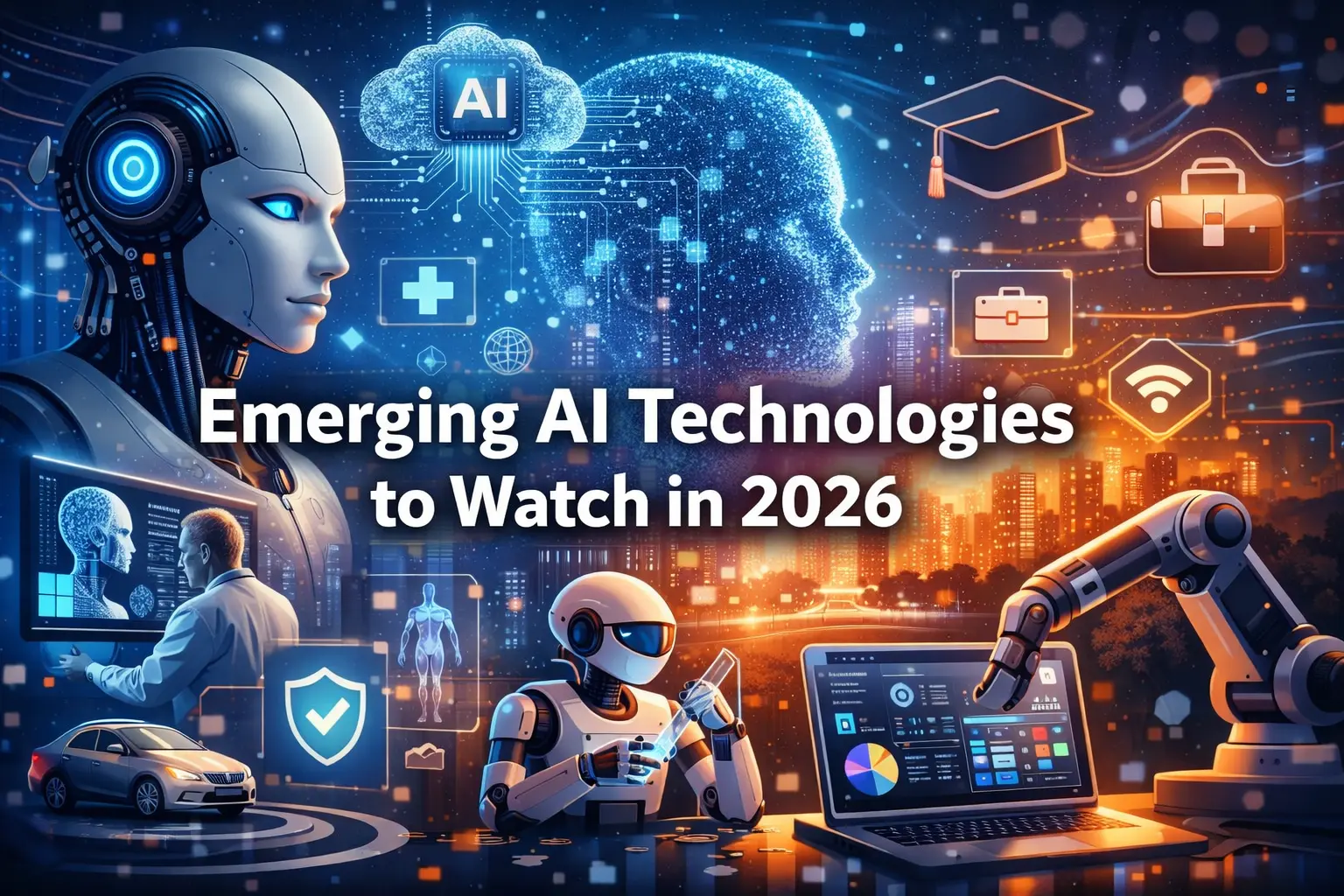
Emerging AI Technologies to Watch in 2026
Artificial Intelligence, or AI, is nowadays not just a thing of science fiction. But in 2026, Emerging AI is no longer the purview of large tech companies and research labs. It’s in homes, schools, hospitals, and companies, large and small. People engage with AI on their phones and through apps without realising it, on smart devices, and even on online platforms. AI can help you decide what to buy, translate a language or identify a disease — and even help you get through your to-do list. With advancing technology, AI solutions are increasingly becoming quicker, more intelligent and more dependable. 2026 is a significant year as many new AI technologies are reaching maturity at this time. These are not symptoms of the future but of today, and they’re changing not just how we work but how we think. Knowing what up-and-coming AI technologies, or approaches that don’t involve obvious companies trying to sell you on their solutions, is useful for individuals and companies to position themselves for the future and make better-informed decisions in an increasingly intelligent and automated world.
Understanding Artificial Intelligence in Simple Terms
 Instead of following rigid, predetermined instructions, these systems process data, identify patterns, and learn from experience. Previous AI tools were simple and limited to performing basic jobs. Today, AI understands human language, recognises faces, predicts outcomes, and answers complex queries. AI is going to be more flexible and adaptive by 2026. It can adapt to new environments without requiring endless human instructions. This capacity means AI is beneficial in a host of fields, including education, health care, business and security. AI is not a substitute for human intelligence but rather complements it by taking over the drudgery of repetitive, data-intensive work. The output of humans working with AI is better, and the process is quicker and more efficient. This is the equilibrium that underpins contemporary AI creation.
Advanced Generative AI and Content Creation
Advanced generative AI refers to systems that can create new content. Generative AI generates new content rather than analysing or interpreting existing data. It can write articles, design images, produce videos, compose music and even write computer code. In 2026, these systems have a far better understanding of (most) context than those of the past and thus will be more natural and useful in the content they generate. Corporations employ generative AI to draft marketing content, reports and product designs. Students and professionals around the world rely on it to save time and enhance creativity. Modern generative AI is different in that it is able to modify its output in real time, taking into account user requirements and feedback, and even generating multiple outputs for a single user query. And rather than being just a tool, this allows it to be a powerful assistant. But responsible use is fundamental to preserve the originality, the correctness and the ethical content generation of the digital world.
Autonomous AI Agents and Digital Workers
Autonomous AI agents are all the rage in 2026. These AIs can operate independently, or in other words, do not require an endless stream of human commands. They can have an objective function, plan over steps, and carry out various tasks. For instance, an autonomous AI agent can check your emails, set up meetings, and conduct preliminary web-based business activities, among other things. In B2B, these agents are like digital workers that you can deploy en masse, who work tirelessly. They provide relief from repetitive tasks for humans and enable those with human staff to simply focus on creative and strategic work. Autonomous AI agents are most useful in customer service, data processing and logistics. As technology advances, these agents become more trustworthy and secure, although the word “agent” is somewhat misapplied to the “bots” at this stage. But they need to be watched closely lest they make mistakes or be misused; we must not lose sight of that. In autonomous AI agents, the effect on efficiency and productivity that can be achieved is tremendous.
Smarter AI Personal Assistants
Personal assistants based on AI have become vastly better by 2026. Previously, they just replied to simple questions or performed simple tasks. Now they express emotions, recall previous conversations, and offer customised guidance. These assistants enable users to manage their daily schedules, establish objectives, and make decisions. For instance, they can recommend healthy habits, study schedules, or financial advice in line with user activity. In the workplace, AI assistants help professionals to organise their day, digest information, and be more productive. This level of customisation helps make technology feel more human and supportive. Enabled by AI assistants, accessibility is also improving for those with disabilities, who have voice control and smart assistance to overcome barriers. As more people come to depend on these systems, they will become even more essential to daily life in 2026.
AI in Healthcare and Medical Innovation
 Healthcare is one of the most promising sectors for AI expansion in 2026. AI systems make it easier for doctors to diagnose diseases more quickly and accurately. They review mammograms, patient histories and lab tests in minutes. This can lead to the early identification of severe disorders such as cancer or heart disease. AI now enables personalised medicine, suggesting treatments based on the patient’s individual data. Hospitals use AI to schedule appointments, keep track of patients and cut down on administrative work. This results in better care at a lower cost. AI is not replacing doctors but rather enabling them to have more information at their fingertips. Battery-powered tools based on AI provide better access to healthcare in rural and underserved regions. As technology continues to advance, AI is helping save lives, improving healthcare outcomes worldwide, and making global healthcare more efficient.
Edge AI for Speed and Privacy
Edge AI is set to be a significant technology to look out for in the year 2026. It enables AI to perform data processing on devices instead of offloading to cloud servers. This makes the systems quicker and more secure. Edge AI is implemented on smartphones, smart cameras, wearable devices, and industrial machines. Since data resides on the device rather than being transmitted to the cloud, privacy is better protected and internet dependency is lessened. This is particularly useful in remote areas. For instance, smart security cameras can recognise faces in an instant without having to send data online. Edge AI also lowers latency — such a vital issue for applications like self-driving cars and medical devices. In 2026, Edge AI enables real-time decisions and safer use of technology in organisations across many industry sectors.
AI in Education and Personalised Learning
 Artificial intelligence is revolutionising education, making learning more customised and efficient. In 2026, AI-based platforms know what each student is good at, what they are weak in, and how fast they learn. Lessons are automatically adapted to each student’s needs. This enables students to learn more effectively and remain motivated. Teachers employ AI to develop lesson plans, grade work, and monitor progress. AI also enables online education, with real-time feedback and assistance. Students from all walks of life can receive a good education with the help of AI. This bridges learning disparities and enhances skills-based education. AI is not a substitute for teachers but a tool that helps them provide a better education. As the mode of instruction is increasingly digitised, AI is instrumental in defining the future of education across the globe.
Ethical, Explainable, and Responsible AI
With the growing power of AI, it is vital to make sure that it is applied responsibly and ethically. In 2026, Explainable AI allows people to know how and why AI-based systems reach decisions. This is really the core in healthcare, finance and the law, where trust and fairness really matter. Ethical AI is about eliminating bias, safeguarding privacy, and guaranteeing security. Governments and companies are establishing rules and guidelines around the use of AI. Responsible AI emphasises that the technology used should positively contribute to society and not harm the individual(s). Users and AI systems are natural partners: Transparency increases trust. When people know how AI works, they are more likely to embrace it and use it. Developing ethical AI is not optional but necessary for long-term success and public trust.
Conclusion:
In all scenarios, 2026 is a milestone for the development of AI. Systems powered by artificial intelligence (AI) are redefining how people live, work and interact with the world. AI is driving new levels of efficiency and opportunities in healthcare, education, commerce, and in the lives of every person on the planet. These technologies are a particular kind of time savers and force multipliers, and they make us smarter in unique ways. But it is also critically important that we develop and use AI safely and ethically so that the benefits are shared by all. Following the progress of understanding and trends for AI may help to prepare oneself for the future. And as artificial intelligence advances, it will help create an even smarter, safer and more connected world. Sophisticated early adopters of AI will capitalise on these benefits in an AI-driven future.

